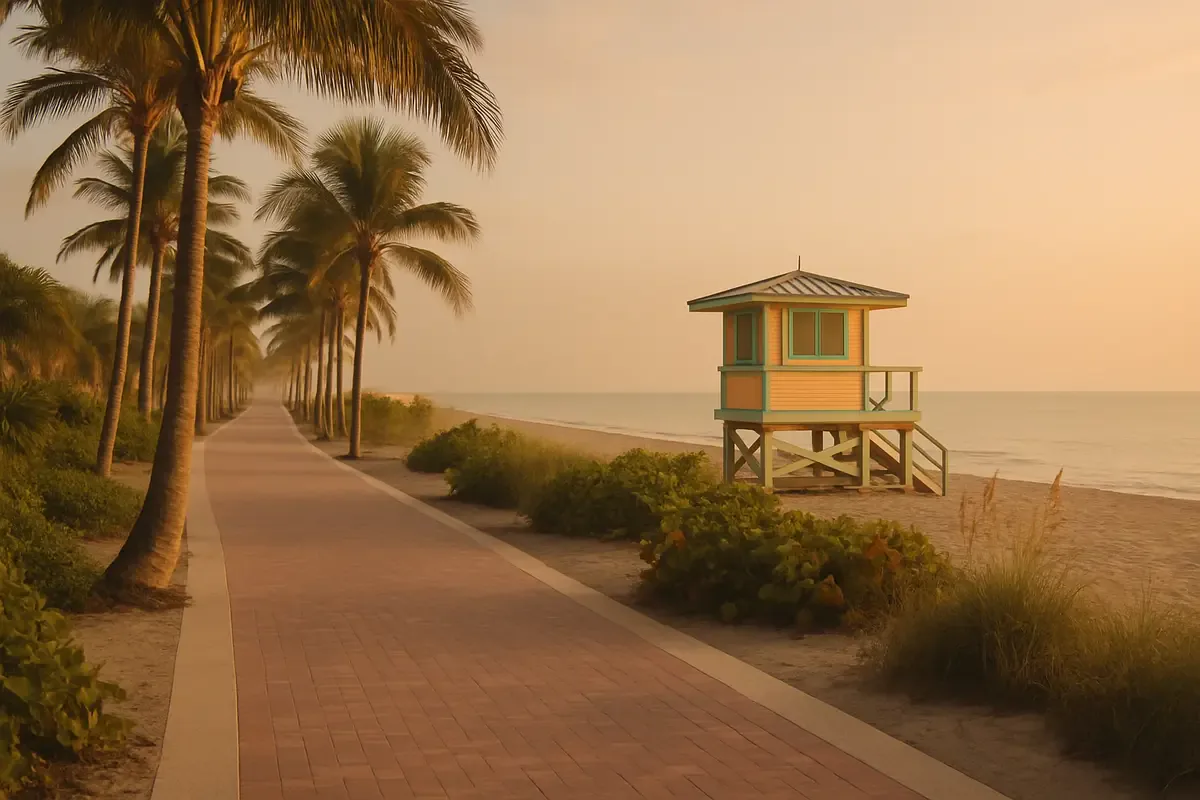
Residential addiction treatment for Hollywood families.
A specialist outpatient program for clients in Hollywood. PHP, IOP, in-house psychiatry, sober-living network, family programming. Same admissions team, 24/7.
Start the conversation Or call directly — (866) 396-2008Local options exist. This is the clinical specialist.
For Hollywood clients, the 50-minute drive up I-95 is the right amount of separation — far enough from Hollywood Beach and the routines tied to active use, close enough for weekend family programming. RECO operates six residences in Delray with addiction-trained house managers, and the same clinical team carries each client from residential through PHP, IOP, and aftercare.
From Hollywood, the route up I-95 to RECO Intensive in Delray Beach runs about 35 miles — roughly 50 minutes when traffic isn’t bunched at the Sunrise interchange. That distance matters more than it looks on a map. Most clients who come to us from Hollywood Beach, Emerald Hills, Hollywood Lakes, Hollywood Hills, or Oakwood don’t commute daily to a residential program; they live on-site in one of our Delray Beach residences for the first phase of care. The fifty minutes of road between home and treatment becomes a clinical asset rather than a logistical problem — enough separation from the people, places, and patterns tied to active use that early recovery has room to take hold, while still keeping family close enough for weekend visits and family programming.
Residential treatment is the most structured level of care RECO offers. It is built for the period after medical withdrawal management is complete but before the skills, routines, and supports of sustained recovery are reliably in place. For most clients, that period runs 30 to 60 days. What follows is what residential at RECO actually looks like, when it is the clinically correct recommendation, and how care continues after the residential phase ends.
When residential is the clinical indication
Not everyone with a substance use disorder needs residential care, and recommending it when a lower level of care would suffice is its own kind of clinical failure. The decision is guided by the ASAM criteria, which evaluate six dimensions: acute intoxication and withdrawal potential, biomedical conditions, emotional and behavioral conditions, readiness to change, relapse and continued-use potential, and recovery environment. Residential is the appropriate recommendation when several of those dimensions point toward needing 24-hour structure — for example, when withdrawal is past but cravings remain destabilizing, when co-occurring depression or anxiety is significant enough that outpatient sessions alone won’t hold, when prior IOP or PHP episodes haven’t sustained, or when the home environment in Hollywood or anywhere else simply isn’t safe or sober enough to support early recovery.
The recovery-environment dimension is the one Hollywood families ask about most often. A home where active use is happening, where a partner is still drinking heavily, or where the daily routine is built around the substance is not a neutral starting point. Residential care temporarily removes that variable so the clinical work of the first thirty to sixty days has a chance.
What 30 to 60 days of residential actually covers
The first week is largely about stabilization — sleep returning to something like a normal cycle, appetite coming back, medication regimens settling, and the client orienting to the rhythm of clinical days. Once that baseline is in place, the work shifts to active treatment. A typical week includes daily group therapy, individual therapy two to three times weekly, family sessions, and psychiatric care as needed. Modalities used across the program include Cognitive Behavioral Therapy, Dialectical Behavior Therapy, Motivational Interviewing, EMDR for trauma-related material, and Trauma-Focused CBT — chosen for each client based on the specific clinical picture rather than applied uniformly.
Medication-assisted treatment is available when appropriate. For alcohol use disorder we use naltrexone (oral or as monthly Vivitrol injection) and acamprosate. For opioid use disorder, buprenorphine and Vivitrol are both options, with the choice driven by the clinical history, the client’s preferences, and what is realistic to maintain after discharge. We treat MAT as evidence-based medicine, not as a moral question. More on those medications is covered in our alcohol and opioid treatment pages.
Alongside the clinical hours, residential is where the unglamorous foundation of recovery gets rebuilt. Regular sleep. Three meals a day. Exercise that isn’t punishment. A schedule that gets up at a normal hour and ends at a normal hour. These rhythms sound trivial, and they are anything but — active addiction systematically dismantles them, and recovery requires they be rebuilt before anything else is going to stick.
The step-down to PHP and IOP
Residential is one phase of a longer arc of care, not the whole arc. Most clients step down from residential to Partial Hospitalization (PHP) for four to six weeks — clinical hours drop from the all-day residential schedule to roughly 30 hours per week, while clients continue to live in a structured sober-living environment. From PHP, the next step is Intensive Outpatient (IOP), typically nine to twelve hours weekly over eight to twelve weeks, with the rest of the day available for work, school, or family reintegration. After IOP, clients transition into aftercare and alumni programming, which continues indefinitely.
The continuity matters. The clinical team that managed residential continues into PHP and IOP. The therapist a client built rapport with in week two of residential is still their therapist in week ten of IOP. There is no hand-off to a different provider, no re-explaining the trauma history to someone new, no losing the thread of the work. For Hollywood clients in particular — who are far enough away that fragmenting care across multiple providers would be especially difficult — that single-team continuity is part of why the program holds.
Real residences, not warehoused beds
RECO operates six residences in Delray Beach. Each one is a real house in a real neighborhood, held to a standard we’d want for our own families — not a clinical-feeling facility, not a warehoused dormitory. House managers are addiction-recovery trained and live on-site; they are part of the clinical model rather than landlords with a key. Meals, transportation to clinical programming, evening meetings, and weekend structure are all part of the design. After residential, clients typically continue in our sober-living network during the PHP and IOP phases — same standards, more autonomy. The full residential program overview covers the housing model in more detail.
Insurance, admissions, and starting from Hollywood
RECO is in-network with most major commercial carriers — Aetna, Cigna, BlueCross BlueShield, United, and others. Our admissions team verifies benefits before any clinical decision is made, so what residential will and will not cover under a specific plan is clear up front rather than a surprise later. You can start the verification through our insurance page or by calling (866) 396-2008.
For Hollywood families, admissions typically begins with a phone call, a clinical assessment, an insurance verification, and a logistics conversation — when to come, what to bring, how the family will stay involved during the residential phase. Transportation from Hollywood Beach, Emerald Hills, or anywhere else in Broward to our Delray campus can be arranged. The first step is a conversation, not a commitment.
Serving residents of: Hollywood Beach, Emerald Hills, Hollywood Lakes, Hollywood Hills, Oakwood.
If it's any of these, we can help.
From Hollywood callers, most asked.
How long is the drive from Hollywood to RECO Intensive?
Will my insurance cover residential treatment?
How is residential different from PHP or IOP?
Can my family in Hollywood stay involved during residential?
What does a typical day in residential look like?
How do you decide if residential is the right level of care for me?
Other hollywood-area communities we serve.



Confidential. No commitment.
Tell us a little and a real human from admissions will call you back. We verify insurance benefits within minutes and tell you honestly whether RECO is the right fit — including if we should refer you elsewhere.