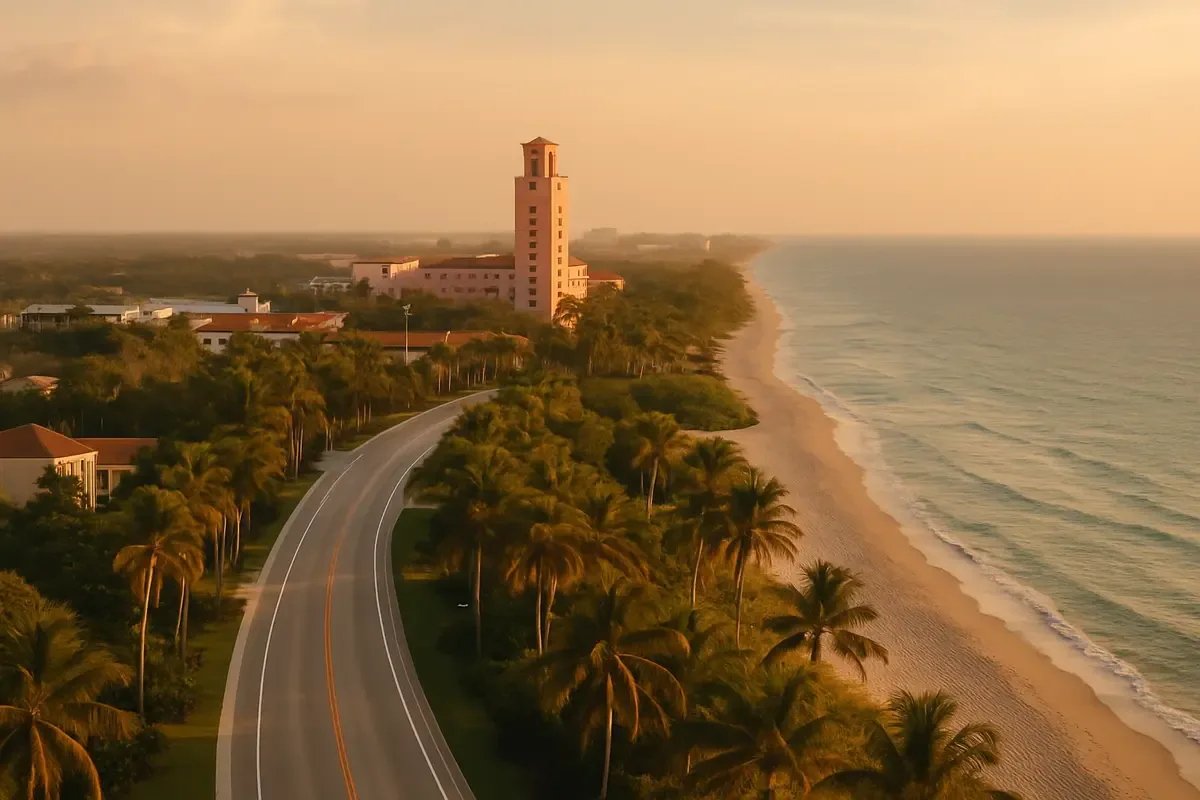
IOP serving Boca Raton — clinical intensity that fits a real life.
A specialist outpatient program for clients in Boca Raton. PHP, IOP, in-house psychiatry, sober-living network, family programming. Same admissions team, 24/7.
Start the conversation Or call directly — (866) 396-2008Local options exist. This is the clinical specialist.
RECO's Delray Beach campus is an 11-mile drive up Federal Highway from Mizner Park — about 20 minutes, shorter than most Boca commutes to I-95. That distance lets Boca Raton clients attend IOP without relocating, keeping jobs at Glades Road offices, school schedules at FAU or Lynn, and family routines intact. The same primary therapist follows your case from PHP through IOP, so step-down doesn't mean starting over.
From Mizner Park or Royal Palm Place, RECO Intensive’s Delray Beach campus sits about 11 miles up Federal Highway — a 20-minute drive that’s shorter than the morning commute most Boca Raton professionals already make to I-95. For someone considering an Intensive Outpatient Program, that distance matters. It’s close enough that IOP fits into the rhythm of an existing life — school pickup at Boca Prep, a part-time shift downtown, a marriage that still needs dinner conversation — without requiring the temporary relocation that residential or out-of-state programs demand. RECO’s IOP runs roughly 15 clinical hours per week across three to five days, and the same primary therapist who worked with you in PHP or residential continues to follow your case as you step down. For Boca Raton residents in Highland Beach, Boca West, or Downtown Boca, that continuity — without uprooting — is often the difference between completing treatment and abandoning it.
Where IOP fits in the continuum
IOP is the bridge. For most clients, it sits between higher-acuity care — partial hospitalization at around 30 clinical hours per week, or residential treatment — and the lighter touch of standalone outpatient therapy or structured aftercare. The clinical reasoning behind that step-down is straightforward: as your stability grows, the scaffolding loosens. Returning to 40 hours of work after 30 hours of clinical care, without an intermediate phase, is the kind of cliff that drives relapse.
Not every client enters at PHP or residential, though. For someone in Boca Raton with a shorter use history, an intact support system, stable housing, and no co-occurring medical instability, IOP can be the appropriate starting level of care. We make that determination using the six ASAM criteria dimensions — intoxication and withdrawal potential, biomedical conditions, emotional and behavioral conditions, readiness to change, relapse potential, and recovery environment. A thoughtful intake assessment, not a sales script, decides where you start.
What 15 hours per week actually covers
Fifteen hours sounds like a number until you sit through a week of it. At RECO, IOP blocks are built around four kinds of clinical work. Group therapy is the largest share — psychoeducation groups that explain the neurobiology of addiction and the mechanics of craving; process groups where clients work through what’s actually happening in their lives that week; relapse prevention groups that map specific triggers and rehearse responses; and skill-building modules drawn from Cognitive Behavioral Therapy and Dialectical Behavior Therapy. CBT work targets the thought-distortion patterns that precede use. DBT skills — distress tolerance, emotion regulation, interpersonal effectiveness, mindfulness — are particularly useful for clients with trauma histories or co-occurring borderline features.
You meet weekly with your primary therapist for individual work. If you’ve been with us since PHP or residential, that’s the same clinician you’ve already built rapport with — not a handoff. Psychiatry appointments are scheduled as clinically indicated, including for medication-assisted treatment when appropriate: naltrexone or acamprosate for alcohol use disorder, buprenorphine or Vivitrol for opioid use disorder. Some weeks include family sessions; others include experiential components — Motivational Interviewing in dyads, EMDR or Trauma-Focused CBT for the trauma threads that almost always run underneath substance use.
Compatible with work, school, and family life
IOP scheduling is deliberately built around the reality that most people in this phase of treatment have somewhere else they need to be. We run morning blocks and evening blocks. A Boca Raton client who works a flexible role at one of the Glades Road offices can attend evening IOP and keep full daytime employment. A parent with school-aged kids at Pine Crest or Saint Andrew’s can sit in morning groups, be home for pickup, and not miss a single afternoon activity. A student finishing a semester at FAU or Lynn can build IOP around a class schedule.
The clinical purpose of this design is not convenience — it’s exposure. Recovery skills only consolidate when you practice them in the environment you actually live in. Going to work, navigating a tense conversation with a partner, declining a drink at a Mizner Park dinner — these are the reps that turn an idea from group into a durable behavior. Residential care removes the environment to stabilize the person. IOP puts the person back into the environment with new skills and a weekly clinical check-in to debug what’s not working.
The transition to aftercare and alumni programming
The step from IOP to aftercare should feel like a gradual tapering, not a discharge. In the final weeks of IOP, your primary therapist will work with you on a written continuing-care plan: which individual therapist you’ll see going forward (often someone in our network or, if you’re staying in Boca Raton, a referred clinician closer to home), what medication management looks like, what your meeting attendance will be, what early warning signs trigger a clinical call.
RECO’s alumni program is the connective tissue after formal treatment ends. Monthly alumni events, peer check-ins, and a recovery community that doesn’t expire when the insurance authorization does. For clients who benefit from continued structured housing during this phase, our sober-living network in Delray Beach provides a peer-supported residential environment alongside IOP or post-IOP outpatient work.
Local proof points, insurance, and how to start
RECO Intensive is accredited by The Joint Commission, and our clinical staff includes licensed mental health counselors, licensed clinical social workers, master’s-level addiction professionals, and board-certified addiction medicine physicians. We work with most major commercial PPO carriers — Aetna, Cigna, Blue Cross Blue Shield, United Healthcare, and others — and a benefits check from our admissions team usually takes under an hour. Full details on what we accept and how verification works are on our insurance page.
For families in Boca Raton, the practical next step is a conversation with our admissions team. We’ll ask about the substance involved, the trajectory of use, prior treatment, current medical and psychiatric status, and what’s happening at home. If IOP is the right level of care, we’ll schedule an intake. If a higher level is clinically warranted, we’ll say so directly — and if a different program is a better fit than RECO, we’ll tell you that too. Call (866) 396-2008 to start that conversation.
Serving residents of: Mizner Park, Royal Palm Place, Downtown Boca, Boca West, Highland Beach.
If it's any of these, we can help.
From Boca Raton callers, most asked.
How long is the drive from Boca Raton to RECO's Delray Beach campus?
Can I keep working in Boca Raton while attending IOP?
What insurance plans does RECO accept?
How long does IOP typically last?
Are families involved during IOP?
What does a typical IOP day look like?
Other boca raton-area communities we serve.



Confidential. No commitment.
Tell us a little and a real human from admissions will call you back. We verify insurance benefits within minutes and tell you honestly whether RECO is the right fit — including if we should refer you elsewhere.