
What Is SMART Recovery Compared With 12 Step Programs
If you are reading this because a meeting felt wrong, that reaction matters. A room can feel welcoming to one person and deeply uncomfortable to another. Sometimes the language lands badly, and sometimes the structure itself feels too rigid when you are already scared. That does not mean recovery is out of reach. It means […]


If you are reading this because a meeting felt wrong, that reaction matters. A room can feel welcoming to one person and deeply uncomfortable to another. Sometimes the language lands badly, and sometimes the structure itself feels too rigid when you are already scared. That does not mean recovery is out of reach. It means you may need a better fit.
When SMART Recovery feels safer than a room full of steps
Why some people look for 12-step alternatives after a hard first meeting
A first meeting can stir up shame fast. You may hear words like surrender, defect, or powerlessness and feel your shoulders tighten. Some people leave thinking, “If this is recovery, I do not belong here.” That feeling is common, especially in early recovery, when every comment seems louder than it should.
That is one reason people search for 12-step alternatives after a rough start. SMART Recovery offers a different tone. It centers self-management and recovery training and gives you language that feels more practical than spiritual. For many people seeking addiction recovery support, that shift lowers the emotional temperature enough to stay engaged.
In treatment settings, the biggest barrier is often not willingness. It is fit. A person may still need structure, but they do not want to feel talked down to. That is especially true for someone exploring SMART Recovery compared with 12-step recovery programs while also weighing Delray Beach rehab or Florida addiction treatment.
“After so many failed attempts at other programs, RECO was the one that finally gave me peace. They cared about every piece of me, and for the first time, I feel whole. I would definitely recommend to anyone!!!”- Trevor O., a 5 star review from RECO Intensive on Google Business Reviews
How self-management and recovery training changes the tone of support
SMART Recovery uses a practical frame. Instead of focusing on identity as an “addict” or “alcoholic,” it teaches tools for change. The tone is collaborative. The goal is not to hand your life to the group. The goal is to help you build skills you can use in daily life.
Here is the part most people miss. The tone alone can change how honest you are. If you expect judgment, you hide. If you expect problem-solving, you talk. That matters in peer support groups and in formal care such as an intensive outpatient setting or a partial hospitalization program.
A client once described it this way: “I could hear myself think again.” That is the kind of change many people want before they can handle deeper work like cognitive behavioral therapy, trauma therapy South Florida, or depression and addiction treatment. In a city like Delray Beach, where the recovery scene is active and visible, tone matters more than most brochures admit.
What a person in early recovery is usually hoping to hear instead of judgment
Early recovery can feel raw. You may be counting hours, not months. You may still be shaky from South Florida detox, or you may be wondering if you need opioid rehab Delray after trying to quit alone. In that state, people usually want three things: clarity, calm, and respect.
They do not need pressure. They do not need lectures. They need to hear that change can be broken into small pieces. That is true for someone coming off fentanyl treatment, heroin recovery, prescription pill addiction, or benzodiazepine withdrawal. It is also true for the person who only knows that their drinking is starting to take more than it gives.
SMART Recovery can feel safer because it starts with skill. It asks what you can do today. It does not require you to accept language that feels foreign before you can receive support. For some, that makes all the difference.
What actually separates SMART Recovery from 12 step programs
The role of personal choice compared with surrender to a higher power
The deepest difference is philosophical. 12-step programs often use surrender, acceptance, and spiritual surrender as core ideas. SMART Recovery centers personal choice, self-direction, and behavior change. Neither model is “easy,” and neither is automatically right for every person.
If you need a 12-step alternative and peer support groups option because spiritual language feels inaccessible, SMART Recovery may fit better. If you feel comforted by tradition, sponsorship, and shared ritual, 12-step support may feel stronger. The point is not to pick a side. The point is to match the model to your readiness, history, and beliefs.
For many people, this becomes clearer once they receive a self-management and recovery training framework for addiction support in treatment. That framework can live alongside evidence-based treatment, group therapy, and family therapy. It also helps in a private rehab setting where the plan should fit the person, not the other way around.
How cognitive behavioral therapy fits into SMART Recovery meetings
SMART Recovery borrows heavily from cognitive behavioral therapy and related methods. CBT helps you spot the link between thoughts, feelings, and actions. That sounds simple, but it is powerful. If you can catch the thought before the drink, pill, or impulsive text, you have more room to choose differently.
This is where SMART Recovery can feel especially useful for people who want structure without heavy religious framing. Many meetings teach tools for cravings, triggers, and decision points. That is a close match for cognitive behavioral therapy in recovery meetings and for evidence-based addiction treatment and coping skills in a clinical program.
What we see most often is this: people do better when the language is simple and repeatable. “Pause, name the urge, challenge the thought, choose a next action.” That kind of repetition supports relapse prevention. It also helps people in mental health IOP settings who are learning how thought patterns affect mood and use.
Why peer support groups can work even when the language and structure are different
Peer support works because people recognize themselves in other people. That is true in 12-step rooms and SMART Recovery meetings alike. The structure may differ, but the healing mechanism is often the same: shared reality, less isolation, and accountability that does not feel clinical.
A man in early treatment once said he liked SMART because nobody told him to “fake it until you make it.” He wanted plain talk. He wanted tools. He wanted people who understood that recovery had to fit around his job, his kids, and the bus ride home through Palm Beach County traffic. That is the kind of fit many people seek in South Florida recovery.
The other advantage is flexibility. Some people attend SMART meetings and still use 12-step meetings. Others do the reverse. That can be wise, especially when the person needs both recovery community and aftercare planning. A strong plan can hold more than one kind of support.
Where abstinence, moderation goals, and relapse prevention ideas can diverge
This is where confusion often starts. 12-step programs usually emphasize abstinence. SMART Recovery also supports abstinence, but it can sound more open to individual goal-setting in the early stages. That does not mean it promotes unsafe use. It means the conversation can be less all-or-nothing.
TopicSMART Recovery12-Step ProgramsCore languageSelf-management, motivation, copingSurrender, acceptance, spiritual growthMain toolsetCBT-based skills, craving tools, planningSponsorship, steps, community accountabilityGoal framingOften individualizedTypically abstinence-focusedTonePractical, secular, skill-basedSpiritual or faith-friendly, tradition-basedFor people with high risk, abstinence is often the safest goal. That is especially true with alcoholism treatment center needs, cocaine detox Florida, or medication-assisted treatment involving Suboxone maintenance or Vivitrol injections. The choice should always reflect safety, not ideology.
Which recovery path fits the problem in front of you
When alcohol recovery calls for a different support fit than drug addiction treatment
Alcohol and drugs can look similar from the outside, but the treatment path may differ. Someone with alcohol dependence may need different trigger work than someone dealing with opioids, stimulants, or sedatives. The detox risks also differ, which is why questions like “how long is detox?” matter early.
If you are trying to find a drug rehab near me option, do not stop at the meeting model. Ask about medical care, withdrawal support, and continuing care. For alcohol use, some people do well with SMART Recovery plus clinical treatment. Others need the added structure of a residential treatment facility or a partial hospitalization program before any meeting-based support feels usable.
This is where the right plan becomes personal. A person with cocaine detox Florida needs a different start than someone seeking heroin recovery or fentanyl treatment. Good care looks at the substance, the severity, and the risks together.
How dual diagnosis treatment changes the choice between SMART Recovery and 12 step programs
When mental health symptoms are part of the picture, the decision changes. Dual diagnosis treatment addresses co-occurring disorders such as depression, anxiety, PTSD, bipolar disorder, and substance use at the same time. NIDA is clear that treating one side alone often leaves the other side active.
That is why dual diagnosis treatment for co-occurring disorders matters so much. If you are coping with anxiety treatment, PTSD treatment, or bipolar disorder therapy, meeting attendance alone may not be enough. SMART Recovery can support skill-building, but it is not a substitute for clinical care when symptoms are severe or layered.
A woman we met in South Florida came in after years of trying to quit on willpower alone. She had panic, poor sleep, and drinking that surged after stress. Once her care plan addressed both mood and substance use, her meetings finally made sense. Before that, every group felt like a language she had not learned yet.
Why depression and addiction, anxiety treatment, PTSD treatment, or bipolar disorder therapy may need more than meeting attendance
This is the part families often feel in their gut before they can name it. A person may be going to meetings and still unraveling at home. They may be sincere, but depression keeps flattening motivation. Anxiety keeps firing the alarm. Trauma keeps pulling them back into old survival patterns.
That is why therapy matters. Dialectical behavior therapy can help with emotion swings and distress tolerance. EMDR trauma therapy may help with trauma processing when used by trained clinicians. Holistic recovery tools like yoga, art, and mindfulness can support regulation, but they work best as part of a larger plan.
If the symptoms are driving the use, then the use will keep returning until the symptoms are treated. That is why depression and addiction treatment in South Florida and PTSD treatment and trauma recovery in South Florida deserve serious attention. The same logic applies to anxiety treatment with co-occurring addiction support.
What families should look for when signs of addiction are paired with trauma or co-occurring disorders
Families usually notice the pattern before the person does. Maybe sleep has changed. Maybe money is missing. Maybe moods are swinging harder, or the person is disappearing after work. Those signs of addiction can sit beside trauma symptoms, and the mix can become hard to read.
Look for more than promises. Look for licensed clinicians, evidence-based treatment, and a clear assessment for dual diagnosis. Ask how the program handles family weekends, communication, and crisis planning. Ask what happens after the first few good days, because that is where relapse risk often rises.
If trauma, mood symptoms, and use are all active, meeting-based support alone may be too thin. That does not mean SMART Recovery has no place. It means it may work best as one part of a wider clinical plan, not the whole plan.
How Delray Beach treatment programs use both structure and flexibility
Where SMART Recovery fits inside a partial hospitalization program or intensive outpatient level of care
In Delray Beach, many people need care that still leaves room for work, family, and real life. That is where PHP vs IOP becomes important. A partial hospitalization program offers more structure. An intensive outpatient schedule offers more flexibility. Both can include groups, skills work, and peer support. SMART Recovery can fit neatly inside either level of care. It works well when a person needs repetition, structure, and a secular tone. It can also complement treatment at a partial hospitalization program for structured recovery support or an intensive outpatient program with group therapy and life skills. 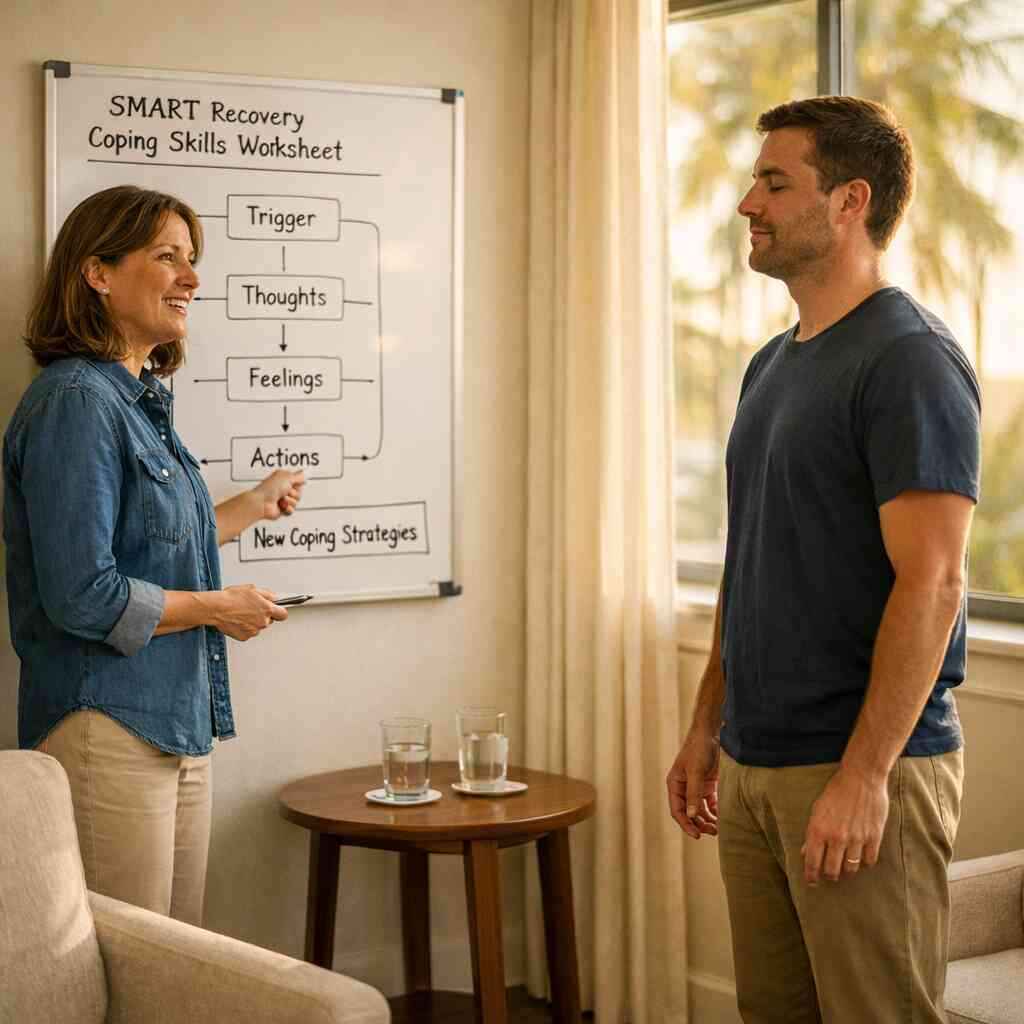
That kind of integration reflects SAMHSA guidelines for continuing care. It also matches what many families want from an outpatient program Delray Beach: enough support to stay stable, but enough freedom to practice new habits in daily life.
Why an outpatient program Delray Beach can pair group therapy with mindfulness meditation and life skills training
Outpatient care works best when it is not just a calendar of appointments. It should teach skills. It should build rhythm. It should help you face the day without feeling swallowed by it. That is why group therapy activities, mindfulness meditation, life skills training, and vocational support matter.
A person leaving a morning group in Delray Beach may walk past Atlantic Avenue, feel the heat rise off the pavement, and realize they need a plan for the rest of the day. That plan might include coping cards, a call list, a meal, and a meeting. The setting matters more than people think. The coastal calm can help, but only if the care is practical.
For some, mindfulness meditation and holistic recovery support adds a useful pause between urge and action. For others, the most useful tool is a simple schedule. The best outpatient programs use both.
How family therapy, aftercare planning, and sober living resources support long term recovery
Recovery rarely fails because people lack hope. It fails because the plan ends too soon. That is why aftercare planning is not an extra. It is part of treatment. The work continues after the first stabilization, when stress, routine, and old contacts return.
Family involvement helps too. Family therapy and aftercare planning for lasting sobriety can reduce chaos at home and improve communication. If housing is unstable, sober living resources in Delray Beach may offer a safer bridge than going straight back to the old environment.
What almost no online guide mentions is this: long-term recovery often depends on small repeated choices, not one big decision. Good aftercare gives you a place to practice those choices before life tests them.
When insurance verification and out-of-network benefits matter for Florida addiction treatment
Money questions can derail good intentions fast. That is why insurance verification matters early, not late. If you are comparing Florida rehabs that take insurance, ask about in-network and out-of-network benefits, plus self-pay options if coverage is limited.
A short call can prevent a long delay. If you are exploring how to verify insurance for Florida rehab treatment, ask for specifics. What levels of care are covered? Is the residential treatment facility option included? Are there limits on mental health IOP or therapy visits?
People often put this off because the call feels awkward. It does not need to be. Better to know than guess.
How a beachside recovery setting near 140 NE 4th Avenue Delray Beach FL 33483 can shape the healing rhythm
Location is not magic, but it matters. A calm setting can make hard work feel more doable. Near RECO Intensive location at 140 NE 4th Avenue Delray Beach FL 33483, the coastal environment and nearby recovery community can support a steadier pace.
Delray Beach has a unique rhythm. It is close to the beach, close to busy downtown energy, and close to a strong local recovery network. That mix can help people rebuild daily structure while staying connected to South Florida recovery resources. It is one reason many people consider Delray Beach rehab for the next phase of care.
What comes next when you are choosing support that will actually hold
How to compare a rehab or recovery community without getting lost in marketing claims
Marketing can sound warm and say very little. Focus on what the program actually does. Ask whether the center offers evidence-based treatment, group therapy, family support, and real aftercare. Ask how it handles relapse risk, mental health symptoms, and step-down planning.
A strong recovery community in South Florida should be able to explain its model plainly. If a program cannot define its levels of care or the therapies it uses, keep looking. RECO Intensive reviews and intake questions can also help you understand the intake process before you commit.
Do not get distracted by glossy words. Get curious about the work.
What questions to ask about licensed clinicians, evidence-based treatment, and dual diagnosis care
You should ask direct questions. Good programs expect them. Here are a few:
- Are the clinicians licensed in Florida?
- How do you assess for co-occurring disorders?
- Do you use CBT, DBT, EMDR, or other named therapies?
- How do you support dual diagnosis treatment?
- What happens after PHP or IOP ends?
If a program cannot answer clearly, that tells you something important. If it can, you will feel the difference right away. For more on how to evaluate a Delray Beach rehab with licensed clinicians, use the same standard you would use for any serious health decision: clarity, specificity, and consistency.
How to decide between meeting based support, PHP, IOP, or a residential treatment facility
The right level of care depends on risk, stability, and daily demands. A residential treatment facility usually fits higher acuity. PHP fits when you need intensive daytime support. IOP fits when life obligations still matter, but structure is still necessary. Meeting-based support fits best when you are stable enough to use it well.
Level of careBest fitWhy it helpsResidentialHigh risk, unstable home, severe useFull support and supervisionPHPNeeds strong daytime structureIntensive therapy with some flexibilityIOPNeeds support while working or parentingConsistent care with more independenceMeetings aloneMore stable, lower immediate riskOngoing peer support and accountabilityIf you are asking what is PHP vs IOP, the answer is simple: PHP gives more hours and more structure; IOP gives more freedom and still keeps regular support. The best choice depends on how safe your day-to-day life feels right now.
Why the right next move is the one that matches your readiness, risks, and daily life in South Florida
The best plan is not the fanciest one. It is the one you can actually use. If you are juggling work, family, withdrawal fear, and insurance questions, start with the most urgent need. If you need detox, address detox. If you need trauma treatment, address that. If you need structure, choose structure.
SMART Recovery may be the right fit, or it may be one layer of a bigger plan. 12-step support may help too. The important thing is matching the support to the problem in front of you, not to someone else’s opinion of recovery.
When to verify insurance, contact RECO Intensive, and map out a plan that includes coping skills and aftercare support
If your situation feels unstable, verify insurance now and ask for an intake review. Ask about insurance verification, dual diagnosis, family involvement, and step-down planning. Ask how coping skills will be taught, practiced, and reinforced after the first week.
You do not have to solve everything today. Start with one call, one insurance check, or one conversation with a trusted family member. If you want a program that understands South Florida detox, opioid rehab Delray, young adult rehab, professionals program needs, and long-term support, contact RECO Intensive and ask how the pieces fit together.
Frequently Asked Questions
Question: What Is SMART Recovery Compared With 12 Step Programs, and how can RECO Intensive help me decide between 12-step alternatives and a more structured recovery plan?
Answer: SMART Recovery is a self-management and recovery training approach that uses practical, evidence-based tools like cognitive behavioral therapy to support motivation for change, coping skills, and relapse prevention. By contrast, 12-step programs often center surrender, spiritual growth, and peer accountability. At RECO Intensive in Delray Beach, we help people compare both options in the context of their own needs, beliefs, and readiness. If a person feels uncomfortable in a traditional meeting, that does not mean recovery is not possible. It may simply mean they need a different fit. Our team can help you explore whether SMART Recovery, 12-step programs, or a blend of peer support groups and clinical care makes the most sense for your recovery planning. We also look at the bigger picture, including signs of addiction, co-occurring disorders, and what level of support is appropriate right now.
Question: How does dual diagnosis treatment at RECO Intensive support people who want SMART Recovery but also need help with depression and addiction, anxiety treatment, or PTSD treatment?
Answer: SMART Recovery can be a strong option for people who want a practical, non-12-step recovery framework, but it is not a substitute for clinical care when mental health symptoms are active. At RECO Intensive, dual diagnosis treatment is designed to address co-occurring disorders at the same time, including depression and addiction, anxiety treatment, PTSD treatment, and bipolar disorder therapy. That matters because untreated mental health symptoms can keep driving substance use, even when someone is motivated to change. Our programs may include group therapy, family therapy, case management, and evidence-based treatment approaches that fit alongside recovery support groups. If needed, we can also help coordinate higher levels of care such as a partial hospitalization program or intensive outpatient services so the person receives support that matches their current stability and needs.
Question: What is the difference between PHP vs IOP at your outpatient program Delray Beach, and when might someone pair those services with SMART Recovery or 12-step programs?
Answer: PHP vs IOP is mainly about intensity and daily structure. A partial hospitalization program provides more hours of support and is often a better fit for people who need a higher level of structure, while intensive outpatient offers more flexibility for work, family, or school. At RECO Intensive, both levels of care can be paired with peer support groups, SMART Recovery, 12-step alternatives, group therapy activities, and coping skills work. This can be especially helpful for someone stepping down from residential treatment facility care or looking for an outpatient program Delray Beach that still feels anchored and supportive. We also consider practical needs like aftercare planning, sober living resources, and family therapy so that the transition into daily life does not feel abrupt. The goal is to build a recovery plan that is realistic, sustainable, and centered on long-term recovery.
Question: Does RECO Intensive offer help for drug rehab near me needs such as opioid rehab Delray, fentanyl treatment, heroin recovery, prescription pill addiction, benzodiazepine withdrawal, or cocaine detox Florida?
Answer: RECO Intensive works with a wide range of substance use concerns, including alcohol recovery and drug addiction treatment needs such as opioid rehab Delray, fentanyl treatment, heroin recovery, prescription pill addiction, benzodiazepine withdrawal, and cocaine detox Florida. We understand that withdrawal, cravings, and relapse risk can differ depending on the substance, which is why treatment planning should be individualized. Depending on the person’s needs, support may include medication-assisted treatment, Suboxone maintenance, Vivitrol injections, relapse prevention, coping skills training, and connection to ongoing recovery support groups. For some people, the safest first step is South Florida detox or a higher level of care before transitioning to outpatient support. We focus on evidence-based treatment with licensed clinicians in a compassionate setting so people can move forward with clarity and a plan.
Question: How do family therapy, aftercare planning, and sober living resources at RECO Intensive support long-term recovery after SMART Recovery meetings or 12-step programs?
Answer: Recovery usually holds up better when the support system extends beyond meetings. At RECO Intensive, family therapy, aftercare planning, and sober living resources can help bridge the gap between treatment and daily life. This is especially important when someone is rebuilding trust, working through trauma therapy South Florida needs, or navigating co-occurring disorders. SMART Recovery and 12-step programs can both be valuable parts of ongoing support, but they work best when paired with a clear plan for structure, accountability, and connection. We also help people think through practical next steps such as vocational support, life skills training, mindfulness meditation, holistic recovery tools, and alumni program involvement. If you are comparing Florida addiction treatment options, our team can help you understand what level of support is needed now and what will help protect long-term recovery later.
Question: What should I look for when choosing a Delray Beach rehab or Florida addiction treatment center, and how do insurance verification, out-of-network benefits, and RECO Intensive reviews fit into that decision?
Answer: When you are trying to choose a rehab, it helps to look beyond marketing and focus on whether the program offers evidence-based treatment, licensed clinicians, dual diagnosis treatment, and a clear intake process. It is also wise to ask about Joint Commission accreditation if applicable, DCF licensed status, and whether the center has experience supporting people with mental health IOP needs, young adult rehab needs, LGBTQ+ affirmative treatment, veterans addiction help, gender-specific treatment, or a professional’s program. Insurance verification matters too. If you are comparing Florida rehabs that take insurance, ask about Aetna, Cigna, Blue Cross Blue Shield, out-of-network benefits, and self-pay options before making a decision. RECO Intensive can help you review those details so you understand what your plan may cover and what level of care is appropriate. You can also ask questions about our Delray Beach recovery community, beachside recovery setting, and the services available at our RECO Intensive location at 140 NE 4th Avenue Delray Beach FL 33483. If you are reading RECO Intensive reviews and want to know whether our approach fits your situation, our intake team can walk you through the options with honesty and care.


