
The Difference Between IOP and Residential Treatment in FL
Navigating the Continuum of Care in South Florida Addiction Treatment Understanding the Florida Rehab Continuum of Care Choosing the right level of care marks a pivotal moment in any recovery journey. The addiction treatment landscape in Florida offers a structured pathway designed to meet individuals exactly where they are. This framework, known as the Florida […]


Navigating the Continuum of Care in South Florida Addiction Treatment
Understanding the Florida Rehab Continuum of Care
Choosing the right level of care marks a pivotal moment in any recovery journey. The addiction treatment landscape in Florida offers a structured pathway designed to meet individuals exactly where they are. This framework, known as the Florida rehab continuum of care, ensures that no person falls through the cracks during their healing process. Each phase builds upon the previous one, creating a seamless transition from medical stabilization to independent living. Understanding this continuum empowers clients and families to make informed decisions about their recovery. It also prevents the common mistake of choosing a program that is either too intense or not structured enough for current needs.
The continuum typically begins with medically supervised detoxification and progresses through residential treatment, partial hospitalization, intensive outpatient programs, and finally outpatient care. Each level offers a distinct balance of clinical oversight, therapeutic engagement, and personal freedom. For example, someone struggling with severe withdrawal symptoms requires a different environment than someone who has achieved initial sobriety but needs relapse prevention skills. The strength of this system lies in its flexibility and adaptability to individual circumstances. By recognizing that recovery is not a one-size-fits-all process, Florida treatment providers have created a model that honors the complexity of addiction.
The Role of Detox Centers as the Foundation
Before any meaningful therapeutic work can begin, the body must first achieve physical stability. The Florida detox to residential treatment pathway starts with medically supervised withdrawal management that addresses both the physical and psychological aspects of substance dependence. Detox centers provide 24/7 medical monitoring to ensure safety during this vulnerable period. Clients receive medications when appropriate to manage uncomfortable symptoms and reduce cravings. This foundational step clears the mind and body, allowing individuals to engage fully in subsequent therapeutic interventions.
Without proper detoxification, the risk of relapse increases dramatically during the early stages of recovery. Medical professionals assess each client’s unique history, substance use patterns, and co-occurring conditions to create a personalized detox protocol. The duration of detox varies depending on the substance involved, the severity of dependence, and individual health factors. Once medical stability is achieved, clients can transition smoothly into the next appropriate level of care. This seamless progression prevents the dangerous gap that often leads to relapse immediately following detox. A reputable rehab center near me will always prioritize this critical first step in the recovery process.
Partial Hospitalization Program Transition as a Bridge
The partial hospitalization program transition serves as a vital bridge between the structured environment of residential treatment and the independence of outpatient care. PHP offers intensive therapeutic services during the day while allowing clients to return to a sober living residence each evening. This structure provides continued clinical support while gradually reintroducing real-world responsibilities and challenges. Clients participate in individual therapy, group counseling, skill-building workshops, and holistic activities during their scheduled hours. The high level of structure still protects against relapse while fostering personal accountability.
Many individuals find that jumping directly from residential treatment to a less intensive program feels overwhelming and precarious. PHP addresses this concern by offering a gradual step-down approach that honors the progress made in earlier phases of treatment. The clinical team continues to monitor progress closely and adjusts the treatment plan as needed. Clients practice applying new coping strategies in a supervised setting before facing full independence. This bridge reduces the shock of transition and significantly improves long-term outcomes. Treatment centers in Florida recognize PHP as an essential component of comprehensive recovery programming.
Delray Beach Rehab Center Continuum and Personalized Care
RECO Intensive exemplifies how a Delray Beach rehab center continuum operates with true personalization at its core. The facility provides multiple levels of care that allow clients to move seamlessly between phases as their needs evolve. This integrated approach eliminates the frustration of starting over with a new provider at each stage. Instead, clients maintain continuity with their primary therapist and clinical team throughout their entire journey. The result is a cohesive treatment experience where each phase builds logically upon the last.
Personalized care means that no two treatment plans look exactly alike at RECO Intensive. The clinical team conducts thorough assessments to identify each client’s unique strengths, challenges, and recovery goals. Some individuals may require extended residential treatment, while others benefit more from a robust intensive outpatient structure. The rehab center near you approach ensures that geographic accessibility does not compromise quality of care. RECO serves clients from South Florida and beyond, offering a welcoming environment for those seeking transformation. This commitment to individualized treatment planning sets the stage for sustainable, meaningful recovery.
Residential Treatment in Delray Beach: The Architecture of Immersive Healing
Residential Treatment for Severe Addiction: A Structured Sanctuary
For individuals grappling with severe addiction, the chaos of daily life often perpetuates the cycle of substance use. Residential treatment for severe addiction provides a structured sanctuary where clients can step away from triggers and focus entirely on healing. This immersive environment removes access to substances while surrounding individuals with round-the-clock clinical support. The architecture of residential care is deliberately designed to promote safety, stability, and profound personal reflection. Clients live onsite in a community of peers who share similar struggles and aspirations. This communal living arrangement reduces isolation and fosters authentic connections that support recovery.
The structured nature of residential treatment addresses the deep-rooted patterns that maintain addictive behaviors. Without the distractions of work, relationships, and environmental pressures, clients can explore the underlying causes of their substance use. Therapeutic interventions target trauma, mental health conditions, and dysfunctional coping mechanisms that have kept individuals stuck. The intensity of this environment accelerates the healing process by providing consistent therapeutic contact throughout each day. Residential trauma-informed care Florida approaches ensure that every interaction considers the client’s history and psychological safety. This sanctuary becomes a launching pad for rebuilding a life grounded in health and purpose.
The Daily Schedule and Trauma-Informed Care in Residential Settings
A well-designed residential treatment daily schedule Florida balances therapeutic intensity with opportunities for rest and reflection. Mornings typically begin with mindfulness practices or gentle movement to center the mind and body. Group therapy sessions address topics such as cognitive behavioral skills, relapse prevention, and emotional regulation. Individual therapy provides a private space to process personal challenges under the guidance of a licensed professional. Afternoons may include psychoeducational workshops, recreational therapy, or creative expression groups. Evenings offer community meetings and structured downtime that encourages bonding among residents.
Trauma-informed care underpins every aspect of the daily schedule in high-quality residential programs. Staff members receive specialized training to recognize trauma responses and respond compassionately rather than punitively. The environment prioritizes physical and emotional safety, avoiding triggers that could retraumatize clients. Therapeutic interventions are designed to empower individuals rather than control them, restoring a sense of agency that addiction often erodes. This approach recognizes that many individuals use substances to cope with unhealed wounds from their past. A rehab center in Delray Beach that integrates trauma-informed principles creates conditions for genuine transformation rather than surface-level compliance.
Family Involvement and Therapeutic Excursions in Residential Programs
Addiction affects the entire family system, which is why residential treatment family involvement Florida remains a cornerstone of effective programming. Family therapy sessions provide a safe space to address communication patterns, rebuild trust, and heal relational wounds. Loved ones gain education about addiction as a disease, reducing blame and shame that often strain relationships. These sessions also equip family members with tools to support their loved one’s recovery without enabling destructive behaviors. The healing that occurs within these sessions often proves just as transformative as individual therapy.
Therapeutic excursions offer residential clients the opportunity to practice new skills in real-world settings while still under clinical supervision. These outings might include attending 12-step meetings in the community, practicing mindfulness in nature, or completing service projects together. Each excursion serves a specific therapeutic purpose, helping clients build confidence in their ability to navigate life sober. These experiences also break up the intensity of daily treatment, providing moments of joy and human connection. A treatment center that incorporates excursions demonstrates commitment to preparing clients for life beyond the program. These activities bridge the gap between the protected environment and the challenges of independent living.
Delray Beach Residential Treatment Benefits for Dual Diagnosis
The intersection of substance use disorders and mental health conditions requires specialized attention that not all programs provide. Delray Beach residential treatment benefits for dual diagnosis clients include integrated care that addresses both conditions simultaneously rather than sequentially. A client battling depression alongside alcohol dependence, for instance, cannot achieve sustainable recovery by treating only one issue. The clinical team at RECO Intensive conducts comprehensive assessments to identify co-occurring conditions such as anxiety, bipolar disorder, PTSD, and personality disorders. This thorough evaluation ensures that the treatment plan targets the full clinical picture rather than just the presenting symptoms.
Dual diagnosis treatment near Delray Beach Florida programs recognize that mental health symptoms often drive substance use as individuals attempt to self-medicate emotional pain. Residential treatment provides the ideal setting for stabilizing both conditions through medication management, psychotherapy, and holistic interventions. The structured environment allows for careful monitoring of medication effectiveness and potential interactions. Clients learn to distinguish between symptoms of their mental health condition and normal emotional fluctuations in early recovery. This clarity reduces confusion and empowers individuals to advocate for their ongoing mental health needs. The comprehensive approach of residential dual diagnosis treatment dramatically improves outcomes compared to treating each condition in isolation.
Intensive Outpatient Programs: Flexibility Meets Evidence-Based Recovery
IOP for Relapse Prevention and Long-Term Sobriety Maintenance
Once individuals have established initial stability through residential or partial hospitalization treatment, the focus shifts to sustaining progress in daily life. IOP for relapse prevention South Florida programs provide the perfect vehicle for translating clinical insights into real-world application. Clients attend therapy sessions several times per week while living at home or in a sober living residence. This arrangement allows individuals to practice coping skills in authentic situations while maintaining robust clinical support. The gradual reduction in structure builds confidence without sacrificing accountability.
IOP for long term sobriety maintenance Delray emphasizes the development of a comprehensive relapse prevention plan tailored to each individual’s triggers and vulnerabilities. Clients identify high-risk situations, early warning signs, and specific strategies for navigating challenges without substances. Group therapy provides a forum for processing real-time struggles and celebrating victories with peers who understand the journey. Individual therapy continues to address underlying issues that may surface as clients encounter new difficulties. The flexibility of IOP accommodates work, school, and family responsibilities while maintaining recovery as a top priority. This balance makes intensive outpatient an ideal option for those transitioning from higher levels of care.
Intensive Outpatient vs Residential Florida: Cost and Commitment Considerations
The residential vs IOP cost comparison Florida reveals significant differences that influence decision-making for many individuals and families. Residential treatment typically involves higher costs due to room, board, 24/7 staffing, and comprehensive services included in the program. Intensive outpatient programs generally cost less because clients are responsible for their own housing and meals. However, cost should never be the sole determining factor when choosing a level of care. The appropriate level depends on clinical needs, severity of addiction, support system availability, and personal circumstances.
Intensive outpatient vs residential Florida step down care considerations also involve time commitment and lifestyle disruption. Residential treatment requires leaving work, family, and daily responsibilities for an extended period. IOP allows clients to maintain employment, fulfill family obligations, and practice recovery skills in their natural environment. Some individuals benefit from the immersive nature of residential treatment before stepping down to IOP. Others may enter IOP directly if their addiction severity does not require 24-hour supervision. A thorough clinical assessment helps determine the most appropriate starting point and progression through levels of care.
IOP Accountability vs Freedom in Early Recovery
The tension between IOP accountability vs freedom early recovery creates a productive dynamic that prepares clients for sustainable independence. Unlike residential treatment, where staff monitor behavior around the clock, IOP trusts clients to make choices between sessions. This freedom carries inherent risk, but also provides invaluable opportunities for growth. When clients face challenges and make mistakes, they can process these experiences with clinical support rather than in isolation. The accountability structure of IOP includes regular drug testing, attendance requirements, and check-ins with the treatment team.
IOP accountability vs freedom early recovery conversations often reveal the ambivalence that naturally arises during this transitional period. Clients may feel excited about regaining independence while simultaneously fearing their ability to maintain sobriety without constant supervision. IOP therapists help clients explore these conflicting feelings and develop realistic strategies for managing them. The program structure provides enough accountability to catch potential relapse early while offering enough freedom to build self-efficacy. This delicate balance teaches clients that accountability and freedom are not opposing forces, but complementary elements of mature recovery.
Outpatient Group Therapy Delray Beach and Community Support
Outpatient group therapy Delray Beach sessions form the heart of the intensive outpatient experience, creating a powerful community of mutual support and shared learning. Groups bring together individuals at various stages of recovery, allowing newer clients to benefit from the wisdom of those further along in their journey. The diverse perspectives within a group expose clients to multiple strategies for managing similar challenges. Facilitators guide discussions while encouraging authentic sharing and respectful feedback among participants. This communal aspect of IOP combats the isolation that often precedes relapse.
The outpatient recovery support Delray Beach options extend beyond formal group therapy to include alumni programs, 12-step meetings, and sober social events. RECO Intensive fosters an alumni community that remains connected long after formal treatment concludes. These ongoing connections provide encouragement, accountability, and friendship that sustain recovery through difficult times. Clients discover that recovery is not a solitary endeavor but a collective journey shared with others who understand. The relationships formed in outpatient group therapy often become some of the most meaningful connections in an individual’s life.
Transitional Living from Residential to IOP: A Step Down Level of Care
The transitional living from residential to IOP Florida step down approach offers clients the best of both worlds during this critical period. Sober living residences provide a substance-free environment with peer support and house accountability structures. Clients attend IOP during the day while returning to structured housing in the evenings. This arrangement maintains the safety net of supervised living while increasing personal responsibility. The gradual reduction in clinical oversight allows clients to test their recovery skills with support readily available if needed.
Florida rehab aftercare planning step down processes begin well before a client completes residential treatment. The clinical team works with each individual to identify appropriate sober living options and coordinate the transition timeline. This thoughtful planning prevents the common pattern of leaving residential treatment without adequate support structures in place. Clients who step down through transitional living and IOP consistently demonstrate better long-term outcomes than those who return directly to their previous environment. The Florida substance abuse treatment intensity continuum recognizes that sustainable recovery requires time, patience, and graduated exposure to independence. A Delray Beach recovery center level of care system that includes transitional living options demonstrates deep understanding of what clients truly need to thrive.
At RECO Intensive, we believe that every individual deserves access to the right level of care at the right time. Our comprehensive programming spans the full continuum, from detox through residential treatment, partial hospitalization, and intensive outpatient services. We invite you to explore how our personalized approach can support your recovery journey or that of someone you love. Contact our admissions team today to discuss which level of care best meets your needs. Your transformation begins with a single courageous step.
Frequently Asked Questions
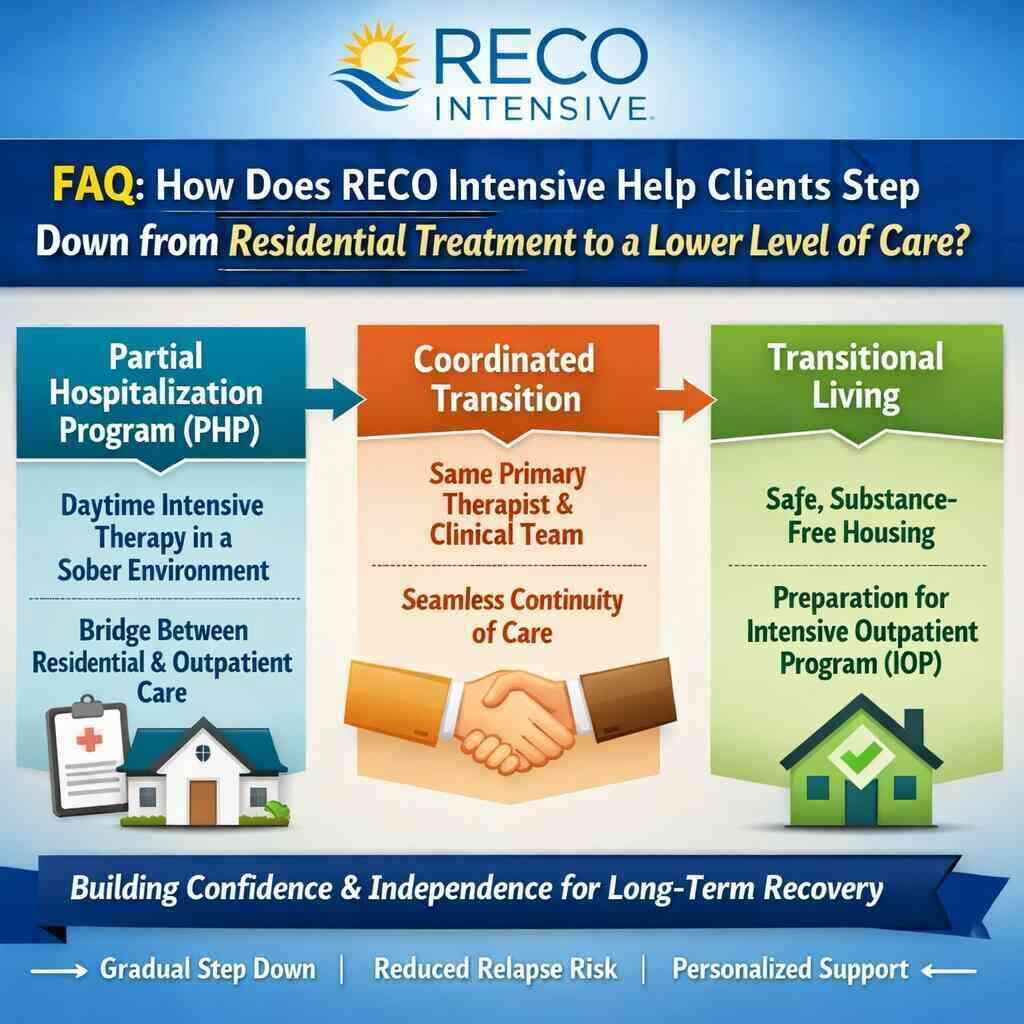
Question: In your blog, The Difference Between IOP and Residential Treatment in FL, you mention the Florida rehab continuum of care. How does RECO Intensive help clients step down from residential treatment to a lower level of care? Answer: At RECO Intensive, we facilitate a step down level of care addiction process that is both seamless and personalized. For clients moving from residential treatment, we often recommend a partial hospitalization program transition as a bridge. This allows them to continue receiving intensive therapy during the day while living in a structured sober environment. Our team coordinates the entire transition, ensuring continuity with the same primary therapist and clinical team. This approach is a core part of the Delray Beach rehab center continuum, reducing the risk of relapse during this vulnerable period. We also incorporate transitional living from residential to IOP options, providing a safe, substance-free residence while clients attend our intensive outpatient program. This gradual reduction in structure builds confidence and prepares clients for long-term independence.
Question: For someone with severe addiction, what are the key benefits of RECO Intensive’s residential treatment in Delray Beach compared to starting with an intensive outpatient program? Answer: For individuals with severe addiction, Delray Beach residential treatment benefits are significant. Our residential treatment for severe addiction provides a structured sanctuary away from triggers, with round-the-clock clinical support and a therapeutic community. This immersive environment is ideal for those who have not been able to achieve stability in less structured settings. In contrast, intensive outpatient vs residential Florida considerations hinge on clinical need. Residential treatment allows for intensive trauma-informed care, a regimented residential treatment daily schedule Florida, and family involvement, all of which lay a strong foundation. After stabilization, clients can step down to an IOP for relapse prevention, ensuring the best outcomes. Our Florida detox to residential pathway ensures clients start their journey with medical stability before transitioning into our residential program, setting them up for success.
Question: How does RECO Intensive’s IOP differ in terms of flexibility and structure compared to residential treatment, especially for those balancing work or family? Answer: The IOP flexibility vs structure at RECO Intensive is designed for those who need robust support while maintaining daily responsibilities. Unlike residential treatment, our IOP allows clients to live at home or in sober living, attending therapy sessions several times per week. This flexibility is key for IOP accountability vs freedom early recovery, as clients practice coping skills in real-world settings while having the accountability of drug testing and regular check-ins. Our evidence-based IOP programs Delray Beach include individual therapy, outpatient group therapy Delray Beach, and skill-building workshops. This structure provides the support needed for IOP for relapse prevention and long-term sobriety maintenance, without the full-time commitment of residential care. For those with mild to moderate addiction, this can be an effective starting point, while for others, it serves as a crucial step down in the Florida substance abuse treatment intensity continuum.
Question: What makes RECO Intensive’s approach to dual diagnosis treatment unique across different levels of care, from detox to outpatient? Answer: Our dual diagnosis treatment levels at RECO Intensive are integrated across the entire Florida rehab continuum of care. We recognize that mental health IOP Florida and residential treatment for co-occurring disorders require a unified approach. Whether a client begins in our Florida detox to residential pathway or directly in IOP, we conduct comprehensive assessments to identify conditions like depression, anxiety, or PTSD. In residential treatment, we offer intensive trauma-informed care and medication management, while our IOP for early recovery continues to address these issues through individual and group therapy. This ensures that dual diagnosis is treated consistently, whether a client is in a residential program or an outpatient one. Our team works together to adjust the treatment plan as the client progresses through different levels of care, providing truly personalized care that leads to better outcomes.
Question: For families concerned about cost, how does RECO Intensive help them navigate the residential vs IOP cost comparison in Florida? Answer: We understand that the residential vs IOP cost comparison Florida is an important factor. At RECO Intensive, we prioritize clinical appropriateness over cost alone. We work with families to assess the client’s needs, explaining that while residential treatment involves higher costs due to accommodations and 24/7 staffing, it can be more cost-effective long-term if it prevents relapse and repeated treatments. For those who qualify, IOP offers a more affordable option without sacrificing quality-our programs are evidence-based and highly structured. We also assist with insurance verification and offer flexible payment plans. Our goal is to guide families through Florida rehab aftercare planning and level of care decisions to ensure the investment leads to sustainable recovery. Ultimately, the right level of care-whether intensive outpatient vs residential Florida step down care-is the one that gives the client the best chance at long-term sobriety.


