
Reviewing 2026 Florida Rehab Tech Trends With Reco Intensive
Opening Portal to the Digital Detox Frontier Why Florida rehab tech trends matter for lasting sobriety Florida’s recovery landscape evolves quickly, and understanding emerging tools empowers families searching for a rehab center near me. Sophisticated sensors, immersive software, and predictive analytics now reinforce every stage of care at leading treatment centers. These advances ensure our […]


Opening Portal to the Digital Detox Frontier
Why Florida rehab tech trends matter for lasting sobriety
Florida’s recovery landscape evolves quickly, and understanding emerging tools empowers families searching for a rehab center near me. Sophisticated sensors, immersive software, and predictive analytics now reinforce every stage of care at leading treatment centers. These advances ensure our Delray Beach rehab center keeps pace with new substance challenges while honoring proven therapeutic principles. Clients gain actionable insights, and clinicians obtain richer data, producing tailored recovery programs that adapt instead of react. Ultimately, integrated technology bridges the gap between aspiration and sustainable sobriety.
South Florida’s diverse community demands treatment services that respect cultural nuance, lifestyle, and unique stressors. Smart platforms translate biometric feedback into personalized coping exercises, giving residents of detox centers an instant lifeline during vulnerable moments. Because relapse drivers differ from person to person, machine learning refines interventions to match individual triggers. When tech amplifies human empathy, an ordinary check-in becomes an empowering conversation. Therefore, Florida rehab tech trends matter for every stage of the healing continuum.
Public health research shows digital inclusion widens access to addiction help even in underserved coastal pockets. Teletherapy, virtual support groups, and voice-guided mindfulness democratize care, ensuring no one is left waiting for transportation or child-care coverage. A rehab center in Delray Beach equipped with cloud infrastructure can reach rural veterans, busy parents, and students juggling coursework. That reach converts awareness into action, encouraging earlier engagement before crises deepen. Early momentum is often the decisive factor in long-term recovery outcomes.
RECO Intensive and the rise of data-driven recovery programs
RECO Intensive stands at the intersection of compassionate counseling and cutting-edge analytics, championing data-driven rehab innovation in Florida. By fusing wearable sobriety trackers with clinically validated assessments, our clinicians witness real-time mood shifts instead of relying on retrospective self-reports. Continuous streams of anonymized data highlight patterns invisible during weekly check-ins, letting specialists adjust medication or therapy assignments quickly. Such proactive care pathways reduce hospitalization risk while boosting client confidence. Information thus becomes inspiration, inspiring clients to celebrate incremental victories.
Our recovery center leverages cloud-based dashboards that translate raw metrics into clear visual narratives. When clients view stress spikes mirrored against craving alerts, accountability grows organically. Counselors overlay those trends with community milestones, like group therapy achievements or alumni mentorship sessions, to spotlight protective factors. The approach reshapes conversations, transforming charts into stories of resilience rather than deficits. As insight deepens, engagement intensifies, and relapse anxiety subsides.
Adaptive AI modules inside our Delray Beach rehab center also support dual-diagnosis mental health care. Algorithms scan linguistic markers for depressive undertones during journaling exercises, flagging moments when integrated therapists can intervene. This gentle safety net respects privacy while forestalling crises that traditionally emerged between appointments. Combine that vigilance with precision medicine addiction care, and each client’s pathway feels handcrafted. Personalized dashboards empower individuals, illustrating how incremental lifestyle changes reshape neurochemical balance.
Blending compassionate care with breakthrough innovations
Technology without empathy feels sterile, so RECO Intensive weaves warmth through every circuit. Licensed clinicians greet clients first, using emotional intelligence to frame how wearables or voice-activated assistants will support treatment services. Transparent explanation fosters trust, ensuring gadgets serve as partners rather than supervisors. Clients can then explore gamified recovery apps during downtime, knowing human mentors remain present if frustrations arise. This synergy secures motivation while preventing digital fatigue.
Our staff also champions ethical AI in behavioral health, performing continual audits for bias or unintended harm. Privacy standards exceed federal benchmarks, and blockchain safeguards maintain secure audit trails for sensitive data. Families therefore experience reassurance instead of surveillance apprehension, allowing them to focus on healing rituals. When confidence in data stewardship rises, participation in remote monitoring becomes voluntary, enthusiastic, and sustainable. Ethical governance thus fuels better outcomes as effectively as any algorithm.
Finally, the campus atmosphere at this rehab center near you embraces creativity alongside circuitry. Music therapy sessions may feature augmented reality visuals that mirror heartbeat rhythms, cultivating deeper emotional release. Outdoor mindfulness walks incorporate biometric feedback mindfulness devices that vibrate gently when stress peaks, signaling a pause for breathwork. These subtle nudges anchor clients in the present moment, converting abstract coping skills into embodied practice. Breakthrough innovations, grounded in empathy, become daily companions on the road to lifelong sobriety.
Intelligent Care Pathways at Our Delray Beach Rehab Center
AI-driven relapse prevention engines shaping treatment services
Artificial intelligence now forms the core of relapse prevention at our Delray Beach rehab center. Sophisticated pattern recognition dissects client histories, biometric streams, and journal language. Those insights power adaptive dashboards that update every hour, not every week. Counselors therefore intervene before cravings escalate, replacing reaction with anticipation. Clients meet their personal algorithm, introduced through the AI addiction treatment services at RECO Intensive portal, and instantly feel a strategic partnership guiding every decision.
The engine ingests anonymized regional data from Florida rehab cohorts, detecting new substance trends early. For example, surges in designer opioid searches trigger curriculum updates inside group workshops. Geolocation signals also spotlight nightlife hotspots where temptation peaks for alumni. When combined with sleep metrics, the model flags vulnerability windows and schedules supportive text nudges. This seamless orchestration turns abstract machine logic into concrete human care, redefining treatment services across our whole recovery center. Such immediacy redefines addiction help, making it proactive instead of reactive.
Machine learning craving detection and real-time mood tracking platforms
Machine learning craving detection systems operate like vigilant companions rather than cold auditors. Wearable sensors capture micro tremors, galvanic skin responses, and subtle changes in speech cadence. These signals flow into encrypted servers where contextual algorithms weigh stressors, location, and social media sentiment. Within seconds, the platform pushes coping prompts tailored to the exact trigger profile. Because feedback arrives during the emotional spike, clients perceive genuine rescue instead of retrospective advice.
Clinicians viewing the dashboard notice color coded curves showing minute-by-minute mood oscillations. A sudden dip alerts the on-call therapist, who initiates a short video check-in through secure telehealth. That personal outreach reminds individuals that support exists wherever they stand, even inside bustling airports. By weaving continuous analytics with compassionate voices, our rehab center in Delray Beach transforms raw numbers into hope. Consequently, families searching for a rehab center near me gain confidence that no crisis goes unseen.
Precision medicine addiction care with genetic insights
Genetic panels now guide dosage decisions, metabolism forecasts, and therapeutic modality selection at our advanced treatment centers. Pharmacogenomic mapping reveals whether a client processes naltrexone quickly or slowly, preventing ineffective cycles. The science falls under precision medicine approaches for substance disorders, yet we translate complexity into clear metaphors during counseling. Clients leave the session understanding why certain medications match their DNA fingerprint. Empowerment grows when biology feels like an ally instead of a mystery.
Our laboratory partners also examine epigenetic markers tied to childhood trauma, allowing therapists to integrate trauma-informed modalities early. When combined with family history, the data predict alcohol sensitivity and stimulant dependence risk. This foresight steers clients toward nutrition plans that bolster neurotransmitter production and repair. Consequently, Florida rehab ambitions evolve from standardized protocols to bespoke blueprints, aligning perfectly with our recovery programs philosophy. Personalized treatment services like these illustrate why a rehab center near you can still feel entirely unique.
Voice-activated mental health assistants are enhancing personalized care
Hands-free voice assistants embedded in private rooms allow clients to request meditations, schedule nurse visits, or log gratitude entries. Natural language processing analyzes tone, selecting uplifting content when frustration rises. The device never replaces human staff; it augments availability during late-night vulnerability peaks. Speech commands remain confidential through edge processing, satisfying even tech-wary participants. Every interaction reinforces autonomy, proving that mental health innovation can remain deeply personal.
Therapists program personalized affirmations, ensuring the assistant mirrors clinical goals established during daytime sessions. Clients recovering in detox centers hear gentle reminders about hydration or posture without feeling policed. Because guidance originates from their own clinician, trust remains intact, reducing alert fatigue. Families exploring a rehab center near me appreciate such seamless support, especially when remote visitation proves difficult. Ultimately, these auditory companions exemplify how our Delray Beach rehab center weaves technology and empathy into one restorative tapestry.
 Immersive Realities Meeting Human Realities
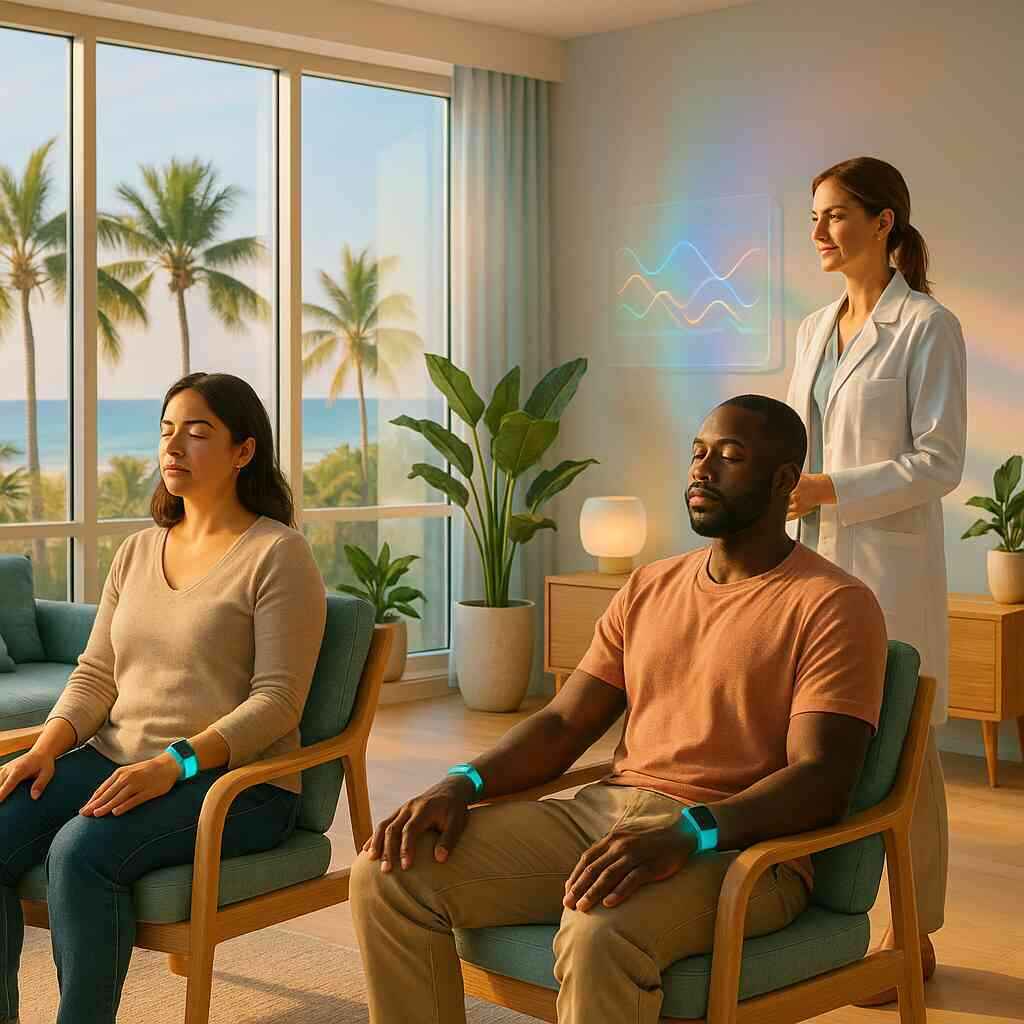 Immersive Realities Meeting Human Realities
Virtual reality exposure therapy for addiction and trauma
Virtual reality exposure therapy for addiction places clients inside vivid yet controlled simulations. Familiar street corners or party scenes appear without the real-world danger. Clinicians at our Delray Beach rehab center supervise innovations, ensuring heart rates stay within safe ranges. Because brains learn through rehearsal, repeated sessions rewrite memory pathways linked to cravings. The result is desensitization that feels empowering rather than frightening.
Additionally, wearable sobriety trackers stream biometric feedback directly into the headset interface. When heart variability suggests distress, the scene pauses and calming prompts appear. This closed-loop design follows best practices described in recent virtual reality exposure therapy research. Clients watch their stress curves flatten in real time, turning abstract coping theories into tangible victories. Consequently, trauma triggers lose intensity while confidence grows daily.
Augmented reality relapse drills during group therapy
Augmented reality overlays transform our group room into a dynamic rehearsal stage. Digital bottles or pill visuals hover harmlessly, inviting participants to practice refusal skills aloud. Because triggers appear while peers observe, social accountability amplifies learning. Clients laugh, stumble, and finally succeed together, forging authentic bonds. Shared success often dissolves the shame that fuels relapse.
The curriculum aligns with our group therapy enhancements with a digital tools approach. Head-mounted devices sync to real-time mood tracking platforms, letting facilitators spot rising tension instantly. A quick breathing exercise can then reset the entire circle. Over time, participants internalize the rhythm: notice, pause, regulate, and respond. Mastery achieved in immersive drills seamlessly transfers to neighborhood cafés and holiday gatherings.
Gamified recovery apps that motivate between sessions
Between formal meetings, gamified recovery apps keep momentum alive. Daily quests award points for hydration, journaling, and attending virtual check-ins. Leaderboards show friendly competition among houses inside our recovery center network. Because victories accumulate visibly, clients awaken eager to defend their streaks. Motivation therefore shifts from external pressure to intrinsic pride.
Furthermore, AI-driven relapse prevention engines personalize the challenge level. Machine learning craving detection adjusts prompts when stress spikes, preventing discouragement. Blockchain patient privacy in treatment centers ensures game data stays secure, encouraging honest participation. Push notifications echo therapist guidance, reinforcing themes addressed earlier. Even mundane tasks feel heroic when framed through well-designed play.
Metaverse-based therapeutic excursions and community building
Our clinicians now host evening circles inside a secure metaverse pavilion overlooking calming ocean vistas. Clients arrive as customized avatars, shedding the self-consciousness that often shadows early recovery. Virtual campfires spark spontaneous storytelling, while mentors float supportive emojis across the sky. Because the space feels both whimsical and safe, vulnerability blossoms quickly. Loneliness dissipates within minutes of shared laughter.
Weekend sessions expand into full-scale quests, such as guided reef dives or mountain climbs. These excursions mirror the spirit of our therapeutic excursions using immersive tech near Palm Beach yet remove logistical barriers. Alumni living far away can still join, strengthening cross-cohort unity. In-world rewards translate to real-world privileges, aligning digital achievements with sober living milestones. The metaverse thus becomes a living extension of our compassionate community.
The Connected Sober Living Ecosystem
IoT-enabled recovery homes and smart home sober living monitoring
Internet-of-Things devices now transform every RECO residence into an intelligent ally for sobriety. Motion sensors notice late-night pacing and gently brighten hallway lights, guiding clients toward a relaxation nook rather than the kitchen. Smart plugs disconnect entertainment systems after agreed curfews, supporting healthy sleep cycles without imposing harsh rules. Temperature, humidity, and even carbon-dioxide levels adjust automatically to maintain restorative comfort, proving that compassionate design can hide inside ordinary fixtures. Because data flows securely to our Delray Beach rehab center dashboard, clinicians spot lifestyle disruptions before stress snowballs.
Clients appreciate that these smart home sober living monitoring features feel like conveniences, not surveillance. The system explains each adjustment through friendly push notifications, reinforcing transparency and consent. Roommates receive collective achievements when environmental scores stay optimal for consecutive days, nurturing community spirit. Family members following progress remotely see graphs instead of guesswork, reducing anxious phone calls. As trust deepens, residents engage more fully with group recovery programs and outdoor excursions.
Wearable sobriety trackers coupled with biometric feedback mindfulness devices
RECO outfitted every participant with lightweight wearable sobriety trackers that log heart variability, perspiration, and micro-movement patterns. When stress markers spike, paired biometric feedback mindfulness devices vibrate softly against the wrist, cueing a quick centering breath. Clients learn to associate physical cues with immediate relief, bridging the gap between theory and practice. The trackers sync to mobile dashboards, letting users celebrate improved resilience metrics through colorful badges. Daily reflections then connect data with emotions, promoting holistic self-awareness.
Our clinicians overlay this biometric timeline with journal entries gathered during treatment services. Surprising correlations often emerge, like caffeine intake preceding agitation during afternoon meetings. Together, client and counselor refine routines, adjusting nutrition or meditation length for tangible gains. Because feedback arrives in real time, motivation stays high and relapse fear wanes. Over weeks, individuals witness objective proof that consistent mindfulness reshapes physiological responses.
5G-powered telehealth detox protocols and therapist connectivity
Reliable, low-latency connectivity now underpins telehealth detox protocols across Florida rehab networks. Portable monitors in detox centers stream vitals to nurses every second, even when clients walk garden paths for fresh air. Encrypted high-definition video sessions support swift medication adjustments without travel delays, vital for rural participants. With 5G service, therapists join family briefings from multiple campuses, ensuring unified guidance regardless of geography. This expanded reach converts isolation into inclusion for communities previously underserved.
Inside our rehab center in Delray Beach, clinicians use handheld tablets to review lab panels during live calls with addiction medicine specialists. Decisions that once required days are now finalized within minutes, stabilizing patients faster. Alumni also benefit; quick weekend check-ins prevent minor cravings from escalating during holidays. Because bandwidth hurdles disappear, empathy flows freely across screens. Consequently, the phrase “rehab center near me” gains new meaning, transcending distance.
Cloud-based EMR integration and blockchain safeguards for patient privacy
Unified electronic medical records support seamless care transitions from inpatient detox to outpatient counseling. Every authorized provider views medication logs, therapy notes, and lab results on one secure interface. Role-based permissions prevent data overload, showing each clinician exactly what they need for efficient addiction help. Automated analytics comb through aggregated entries, flagging emerging mental health concerns before they escalate. These insights fuel continuous improvement across our treatment centers.
Security remains paramount, so we pair encryption with immutable audit trails. Our commitment to privacy & blockchain safeguards for patient data reassures clients who fear stigma or identity exposure. Smart contracts also manage consent flags, empowering individuals to grant or withdraw access instantly. Regulators appreciate transparent compliance, and insurers process claims faster thanks to verifiable timestamps. When trust in data handling rises, client engagement follows suit.
Contactless medication adherence sensors securing treatment outcomes
Tiny, disposable sensors embedded within pill dispensers now confirm dosage without intrusive supervision. When a client tilts the bottle, the sensor timestamps the movement and updates adherence charts wirelessly. If a scheduled window passes unused, the platform delivers a discreet reminder followed by human outreach only when needed. This tiered approach preserves dignity while protecting health, crucial for dual-diagnosis patients juggling complex regimens.
Real-time adherence data also refines personalized care pathways for Florida recovery programs. Pharmacists notice subtle patterns, such as weekend delays linked to social obligations, and suggest blister packs or alternative timing. Counselors integrate these findings into relapse prevention plans, connecting biological stability with behavioral strategies. Families gain peace of mind, knowing support systems activate automatically should doses be missed. As technology shoulders routine vigilance, relationships can focus on encouragement rather than policing.
Closing Reflections on Ethical Tech Powered Recovery
 Closing Reflections on Ethical Tech Powered Recovery
Balancing human empathy and ethical AI in behavioral health
Human connection anchors every innovation inside our Delray Beach rehab center. Counselors lead each algorithm, ensuring residents feel heard before data points speak. This priority safeguards empathy while ethical AI in behavioral health handles pattern recognition, scheduling, and gentle nudges. Because technology shoulders repetitive monitoring, therapists devote energy to nuanced conversations that spark genuine transformation. The result is a Florida rehab model where silicon and compassion collaborate, not compete.
Developers now train algorithms on inclusive datasets drawn from varied treatment centers across South Florida. Bias audits run continuously, and any drift triggers immediate human review. Digital twin modeling in rehab planning also supports fairness by stress-testing interventions across age, culture, and co-occurring diagnoses. When simulated clients thrive, real clients encounter safer programming. This rigorous oversight preserves dignity while amplifying effectiveness.
Sustainability and cybersecurity in rehab tech infrastructure
Sophisticated systems demand responsible resource use, so our recovery center invests in green cloud partners powered by renewable energy. Efficient edge devices reduce bandwidth strain, extending battery life for wearable sobriety trackers and smart home sober living monitoring equipment. Fewer replacements mean less e-waste and smaller carbon footprints. Sustainability, therefore, becomes another pillar of healing, showing clients how mindful choices scale beyond personal wellness.
Cybersecurity remains equally vital. Blockchain patient privacy safeguards and zero-trust architectures wrap every data packet in multilayer encryption. Regular penetration tests simulate emerging threats, keeping defenses several steps ahead. Staff complete quarterly drills that blend technical protocols with empathetic communication, ensuring no alarm compromises client trust. As a result, confidential insights fuel personalized care without exposing vulnerabilities.
Data analytics for continuous improvement at treatment centers
Actionable metrics drive program refinement inside our rehab center in Delray Beach. Aggregate dashboards reveal which mindfulness prompts reduce late-night craving alerts or which group sessions boost sleep quality. Teams review this intelligence weekly, adjusting curricula before small issues snowball into setbacks. Such nimble iteration turns recovery programs into living organisms that learn alongside their participants.
Predictive analytics also correlates environmental factors with outcomes, sharpening future planning. When humidity spikes align with agitation, facility managers adjust climate controls preemptively. These micro-calibrations demonstrate respect for mind-body interplay. Families searching for a rehab center near me appreciate seeing measurable progress, while donors witness transparent stewardship of resources. In every sense, numbers nurture hope.
Inviting readers to explore RECO Intensive innovations and next steps
Technology’s ultimate purpose is to strengthen human resilience, and RECO Intensive remains committed to that mission. Visitors touring the campus witness VR studios beside art rooms, biosensor labs beside meditation gardens. This balanced ecosystem invites both curiosity and calm, proving advanced tools can still feel welcoming. Prospective clients often remark that the atmosphere feels more like a modern wellness village than a clinic, yet evidence-based rigor infuses every moment.
We invite you to experience these breakthroughs firsthand. Visit our website to explore integrated mental health support in Delray rehab and schedule a personalized consultation. Whether you need immediate addiction help or guidance for a loved one, our team stands ready to craft a bespoke path forward. Together we will transform data into wisdom and wisdom into lasting sobriety.
Frequently Asked Questions
Question: How does RECO Intensive use AI-driven relapse prevention engines to support clients in their Delray Beach rehab center?
Answer: Our AI-driven relapse prevention platform continuously analyzes biometric data, journal language, sleep patterns, and geolocation signals to predict vulnerability windows before cravings peak. Inside our Delray Beach rehab center, counselors receive color-coded dashboards that refresh every hour, allowing proactive outreach rather than reactive intervention. When stress indicators rise, the system sends personalized coping prompts or schedules an instant telehealth check-in. This seamless integration of machine learning craving detection with compassionate human support dramatically reduces hospitalization risk and reinforces sustainable sobriety.
Question: In Reviewing 2026 Florida rehab tech trends with RECO Intensive, you discuss wearable sobriety trackers-how do these devices integrate with real-time mood tracking platforms to enhance treatment services?
Answer: Each client receives a lightweight wearable sobriety tracker that logs heart-rate variability, galvanic skin response, and micro-movement patterns. These data streams flow into encrypted servers where real-time mood tracking platforms correlate physiological shifts with environmental triggers. If a spike in anxiety coincides with proximity to past nightlife hotspots, the system vibrates a paired biometric feedback mindfulness device and delivers an in-app breathing exercise. Clinicians can then review trend graphs during one-on-one sessions, turning abstract numbers into actionable insights that personalize our Florida rehab treatment services.
Question: What role do virtual reality exposure therapy for addiction and augmented reality relapse drills play in your group therapy programs?
Answer: Virtual reality exposure therapy for addiction places clients inside realistic yet controlled simulations-such as a familiar party scene-so they can practice refusal skills while monitoring their physiological responses. Augmented reality relapse drills extend this experience into group settings; digital bottles or pills appear in the room, encouraging participants to rehearse coping strategies together. These immersive tools, combined with voice-activated mental health assistants and gamified recovery apps, transform traditional group therapy into an engaging, data-rich environment that accelerates skill acquisition and strengthens community bonds.
Question: How does RECO Intensive ensure blockchain patient privacy in treatment centers while utilizing cloud-based EMR integration?
Answer: We employ a hybrid architecture: cloud-based EMR integration centralizes treatment notes, lab results, and medication logs for authorized providers, while blockchain technology adds an immutable audit trail that records every data access event. Smart contracts allow clients to grant or withdraw consent instantly, satisfying both HIPAA requirements and personal privacy concerns. This zero-trust framework protects sensitive information across our detox centers, recovery homes, and telehealth detox protocols, reinforcing trust and compliance throughout the Florida rehab ecosystem.
Question: Can you explain how precision medicine addiction care and genetic testing for addiction risk personalize recovery programs for individuals searching for a rehab center near me?
Answer: Precision medicine addiction care begins with pharmacogenomic and epigenetic testing. By analyzing DNA variants that influence how each individual metabolizes medications like naltrexone or buprenorphine, our clinicians tailor dosages to maximize efficacy and minimize side effects. We also examine genetic markers linked to alcohol sensitivity, stimulant response, and trauma-related stress pathways. These insights inform customized nutrition plans, therapy modalities, and medication regimens, ensuring that every recovery program feels handcrafted-no matter where you are searching for a rehab center near you.


