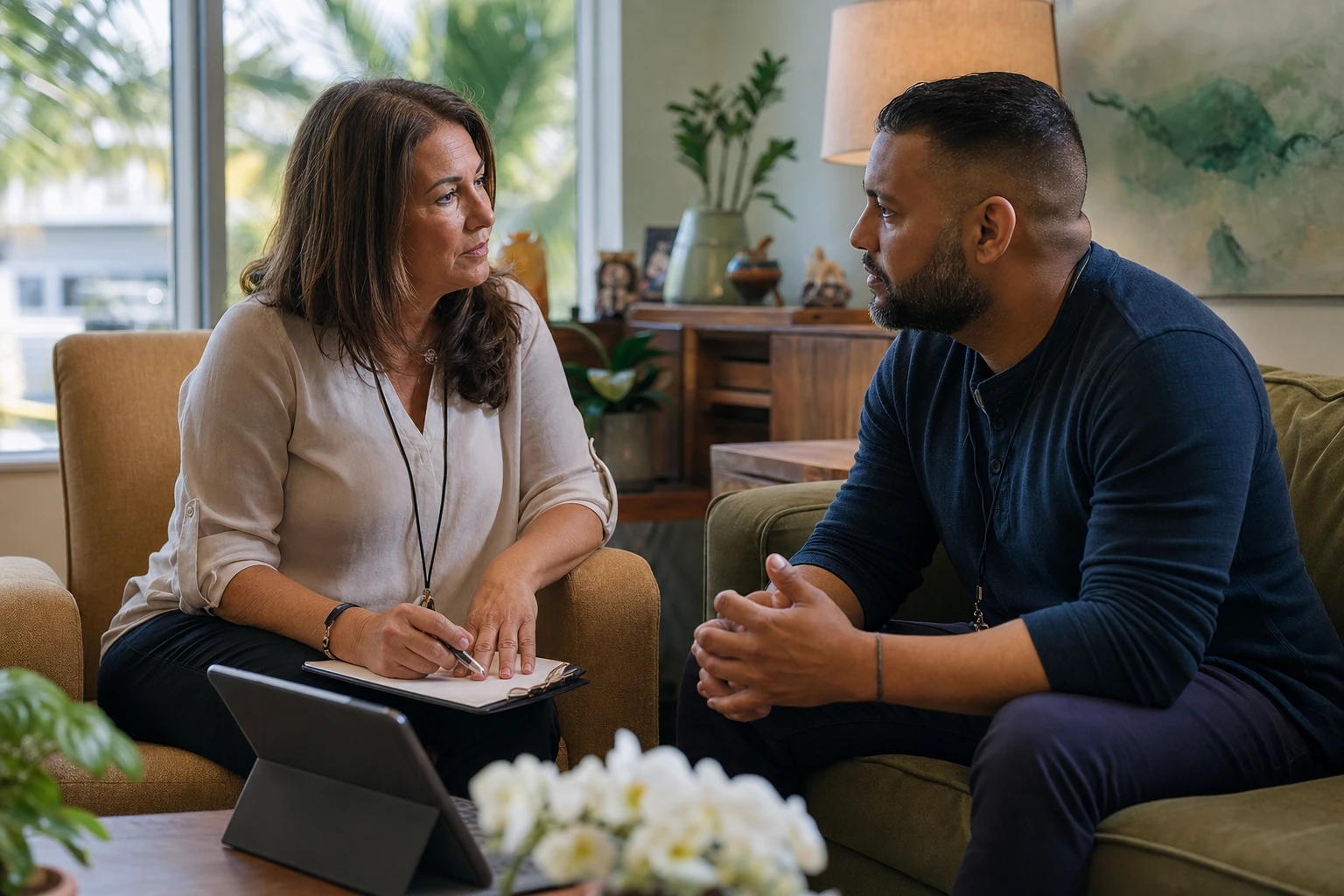
Every successful recovery starts with an honest, complete picture of what's actually happening — clinically, medically, and personally. At RECO Intensive in Delray Beach, every client begins with a multi-disciplinary assessment that becomes the blueprint for everything that follows.
What the assessment looks like at RECO Intensive
Your intake assessment is a structured 90-to-120-minute conversation with a master's-level clinician — not a 20-question intake form. We work through your substance use history, mental health history, trauma history, medical comorbidities, family system, and what you're hoping recovery can give you back.
Alongside the clinical assessment, our medical team conducts a physical evaluation: vital signs, full labs, sleep history, medication reconciliation, and a withdrawal-risk screen. For clients who fit, we offer a qEEG brain map within the first week to identify dysregulation patterns that shape the personalized care plan.
Findings from intake feed a written treatment plan reviewed by the full clinical team within 72 hours of admission. You see the plan. You give input. It is yours.
What we screen for
- Substance use: primary and secondary substances, frequency, withdrawal risk, prior treatment episodes
- Co-occurring mental health: depression, anxiety, PTSD, bipolar disorder, ADHD, eating concerns
- Medical comorbidities: sleep, cardiovascular, hepatic, endocrine, pain conditions
- Trauma history: single-incident and complex trauma, sensitively explored at your pace
- Recovery capital: family, work, housing, finances, prior recovery supports
Who the RECO assessment is built for
Anyone considering RECO Intensive's IOP, PHP, or residential program goes through this assessment. It serves both clients new to treatment and those returning after a previous episode that didn't stick — because a good assessment surfaces what was missed the first time.
How assessment integrates with the rest of your plan
The assessment is not a one-time event. We re-assess at week two, week four, and at discharge — because what a client needs at intake is rarely what they need three weeks in. Your therapist, psychiatrist, and case manager review findings together in our weekly multi-disciplinary case meeting and adapt the plan accordingly.
Why the RECO approach is different
Many treatment programs use intake as a billing exercise. We treat it as the most important clinical event of the first week — because every downstream decision (which therapist, which group track, which medications, which level of care) flows from what we learn at intake. Time spent here is the highest-leverage investment your recovery can make.