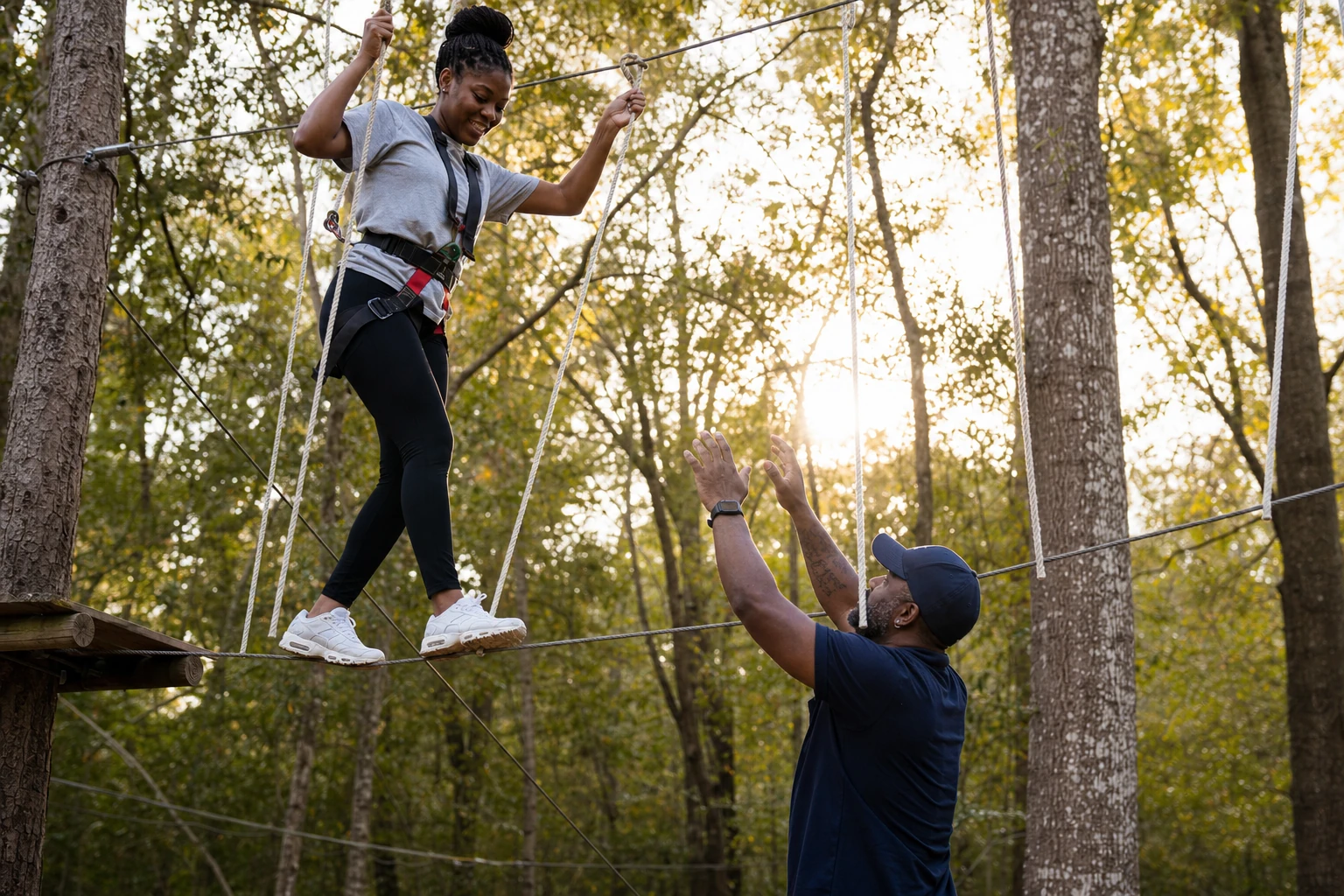
The ropes course is one of the most powerful experiential interventions in addiction recovery — a controlled environment in which clients face physical and emotional challenge with full clinical support. RECO Intensive's ropes-course excursions are facilitated by trained adventure-therapy professionals alongside our clinical team.
What ropes-course days look like at RECO Intensive
A half-day excursion to a vetted ropes course facility, including both low-element team-building (group problems, low-balance work) and high-element individual challenges (climbing, zip line). A trained facilitator handles the technical safety; our clinician handles the emotional processing. Pre-event intention setting and post-event group reflection bracket the experience.
What the day includes
- Pre-event circle and intention setting
- Low-element group challenges (cooperation, communication)
- Optional high-element individual challenges (always opt-in)
- On-the-spot somatic coaching during challenging moments
- Post-event group reflection
- Individual-therapy integration in the following week
What therapeutically happens on a ropes course
Controlled exposure to physical fear surfaces the exact nervous-system patterns that show up under emotional stress — freeze, fight, flight, or fawn. With a clinician present at the moment of activation, clients get to feel their pattern, name it, and practice a regulated response. The body learns something it can't learn in a therapy room: that activation can be moved through, not avoided.
Who benefits most
Clients with PTSD or significant trauma history (with clinical screening for appropriateness). Avoidance-pattern clients whose recovery requires confronting fear directly. Clients whose addiction was tied to risk-seeking or sensation-seeking. Professionals whose composed exterior hides significant autonomic dysregulation. Anyone whose recovery includes building somatic confidence.
How ropes-course experiences tie to the rest of treatment
Observations feed individual therapy and the weekly clinical team meeting. Clients often describe the ropes course as a turning point in treatment — the moment something shifted. The shift is real; the integration happens in the days and weeks afterward.
Why the RECO approach is different
Many programs occasionally offer ropes-course outings. Few clinically prepare for them, screen for appropriateness, integrate them into individual therapy, and follow up systematically. We treat adventure-therapy modalities with the same clinical rigor as office-based interventions.