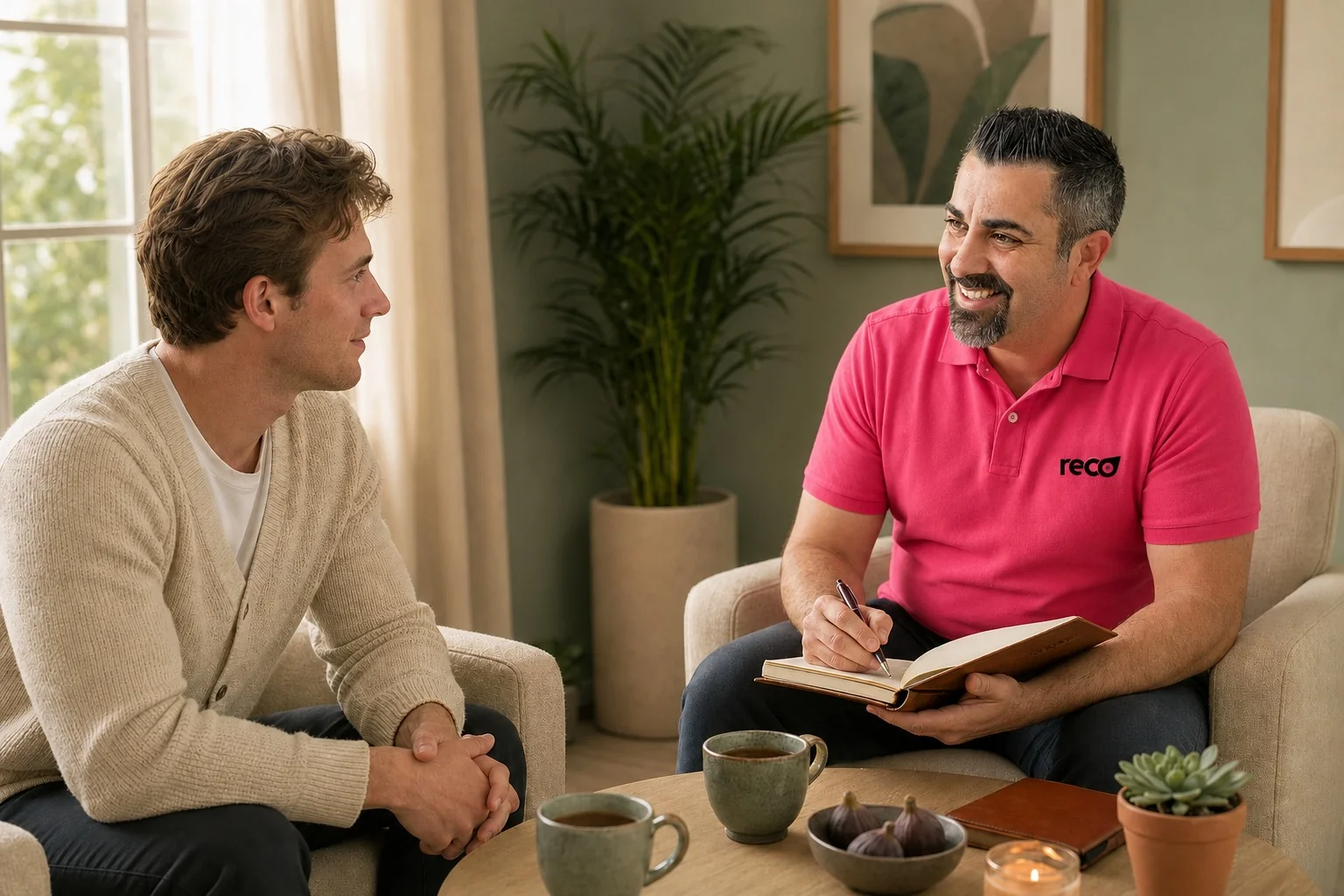
Treatment built around the person, not the program
At RECO Intensive, every clinical decision starts with a single question: what does this specific person need to build a sustainable recovery? That answer shapes everything from your first assessment to the day your primary therapist transitions you into long-term aftercare.
Six pillars that shape every treatment plan.
These aren't marketing themes. They're the clinical and structural commitments that drive every decision RECO's team makes — from intake through long-term aftercare.
One Clinician, Every Level of Care
You keep the same primary therapist from your intake assessment through residential, PHP, IOP, and into aftercare planning. The therapeutic relationship does not reset each time your level of care changes. That continuity is not a convenience feature. It is a clinical decision that reduces trauma re-exposure and strengthens the alliance that evidence consistently identifies as one of the strongest predictors of recovery outcomes.
Substance-Specific, Evidence-Based Protocols
Opioid use disorder is not treated identically to alcohol use disorder, and neither should be treated identically to a primary stimulant or benzodiazepine presentation. RECO uses substance-specific clinical pathways built on protocols with peer-reviewed evidence: medication-assisted treatment where indicated, EMDR for trauma that underlies use, dialectical behavior therapy for emotional dysregulation, and cognitive behavioral therapy for the cognitive distortions that sustain active addiction.
Trauma-Informed at Every Level
Unresolved trauma is present in the majority of people who enter addiction treatment. Treating the substance without addressing the underlying wound rarely produces lasting change. Every clinician at RECO is trained in trauma-informed care principles, and EMDR is embedded into the treatment schedule for clients where trauma is a primary driver, not offered as an optional add-on.
Family Integrated From Day One
Addiction reorganizes family systems in predictable and damaging ways. Recovery requires that the family system changes alongside the person in treatment. RECO begins structured family work at intake, not at the midpoint of treatment when patterns have already re-solidified. Family sessions, education, and multifamily group are built into the weekly clinical schedule.
ASAM-Guided Level-of-Care Decisions
Level-of-care placement at RECO is determined by ASAM criteria, the standard set by the American Society of Addiction Medicine, assessed across six dimensions: acute intoxication and withdrawal potential, biomedical conditions, emotional and behavioral conditions, readiness to change, relapse potential, and recovery environment. That assessment drives where you start and informs every step-up or step-down decision during your continuum.
A Continuum, Not a Discharge
Treatment does not end at a completion certificate. RECO's continuum extends from medically managed detox through residential care, partial hospitalization (PHP), intensive outpatient (IOP), sober living, and structured alumni programming. The goal is not to discharge you. It is to graduate you, with a support network and a therapist who knows your history, into a life that does not require substances to function.
Founded on a clinical conviction that generic treatment fails most people
RECO Intensive opened in 2010 in Delray Beach, Florida with a specific premise: that the treatment industry was delivering a standardized product to a problem that is never standardized. Two people presenting with opioid use disorder may share a diagnosis and almost nothing else. Their trauma histories, family systems, psychiatric co-occurring conditions, substance histories, and readiness to engage in treatment differ in ways that determine whether a given protocol will help or be irrelevant.
The founding clinical team built RECO's model around assessment depth and individualization. The intake process at RECO is longer and more comprehensive than most programs because accurate clinical placement cannot happen without it. The six-dimensional ASAM assessment is conducted by licensed clinicians, not intake coordinators reading from a checklist. Psychiatric evaluation happens at admission, not weeks into treatment when a missed co-occurring condition has already undermined the clinical work.
Delray Beach has a concentration of treatment programs that is unusual in any U.S. city. Families researching care for a loved one, or individuals looking for treatment for themselves, have options. What distinguishes RECO is not a resort amenity list. It is a clinical architecture that keeps the same therapist with the same client through every level of care, that integrates psychiatric services with addiction counseling rather than siloing them, and that treats the family system as a primary focus rather than an afterthought scheduled on Family Weekend.
If you are calling about a loved one, or calling about yourself, the question worth asking any program is not "what do you offer" but "how does what you offer respond to what I specifically need." That is the question RECO was built to answer.

The evidence-based modalities that drive every treatment plan
Evidence-based treatment is a phrase used frequently in addiction care and defined rarely. At RECO, it means that the therapeutic modalities used in individual sessions, group programming, and family work have been studied in peer-reviewed research and demonstrated efficacy for the presentations they are applied to.
Cognitive behavioral therapy (CBT) is the most researched modality in addiction treatment. RECO uses it in both individual and group formats to address the automatic thought patterns, core beliefs, and behavioral sequences that sustain substance use. Dialectical behavior therapy (DBT) is used for clients whose primary vulnerability is emotional dysregulation, an area where CBT alone is often insufficient.
Eye movement desensitization and reprocessing (EMDR) is integrated into the individual therapy schedule for clients with identifiable trauma history. EMDR is not a supplemental offering at RECO. It is a clinical tool embedded into the primary treatment plan when trauma is assessed as a driver of use, which is more often the case than not.
Motivational interviewing (MI) shapes the clinical stance of every therapist at RECO. It is not a technique applied only in the early days of treatment. It is the framework through which ambivalence is explored throughout the continuum, because ambivalence about change does not resolve at admission and pretending otherwise produces a brittle recovery.
Psychiatric integration means that the prescribing psychiatrist and the primary therapist communicate weekly, not in a quarterly case conference. Medication-assisted treatment (MAT) for opioid and alcohol use disorders is offered where clinically indicated and supported by client consent. The decision to use buprenorphine, naltrexone, or other FDA-approved medications is a clinical one, not a program philosophy one.
How we treat addiction as a family disease from the first day
Addiction does not happen inside one person while the people who love that person remain unchanged. By the time a family calls RECO, the family system has reorganized itself around the using behavior, often over years. Roles have shifted. Communication has narrowed. Trust has fractured in ways that are specific to each relationship. Recovery that does not address those dynamics will eventually run into them.
RECO begins family engagement at intake, not at week three. The first family session is scheduled during the first week of treatment. The purpose is not to present a program overview. It is to begin the clinical work of mapping the family system: identifying enabling patterns, communication breakdowns, and the ways each family member has adapted to living with addiction in the home.
Family therapy at RECO is delivered by licensed clinicians, not by peer support staff facilitating a support group. Sessions are structured around evidence-based family systems approaches. Multifamily group runs weekly and gives family members a space to hear from other families navigating the same dynamics, which consistently reduces the isolation and shame that make change harder.
Family education addresses the neuroscience of addiction, the research on enabling and detachment, and the realistic expectations that should accompany early recovery. Families who enter treatment education believing that a 28-day program produces a "fixed" loved one leave with a more accurate and more useful understanding of what sustained recovery actually requires.
If you are a family member calling before your loved one has agreed to treatment, RECO can work with you. Understanding what a family-centered clinical model looks like is useful information for the conversation you may still need to have. Call (866) 396-2008 to speak with an admissions counselor who can answer your specific questions.
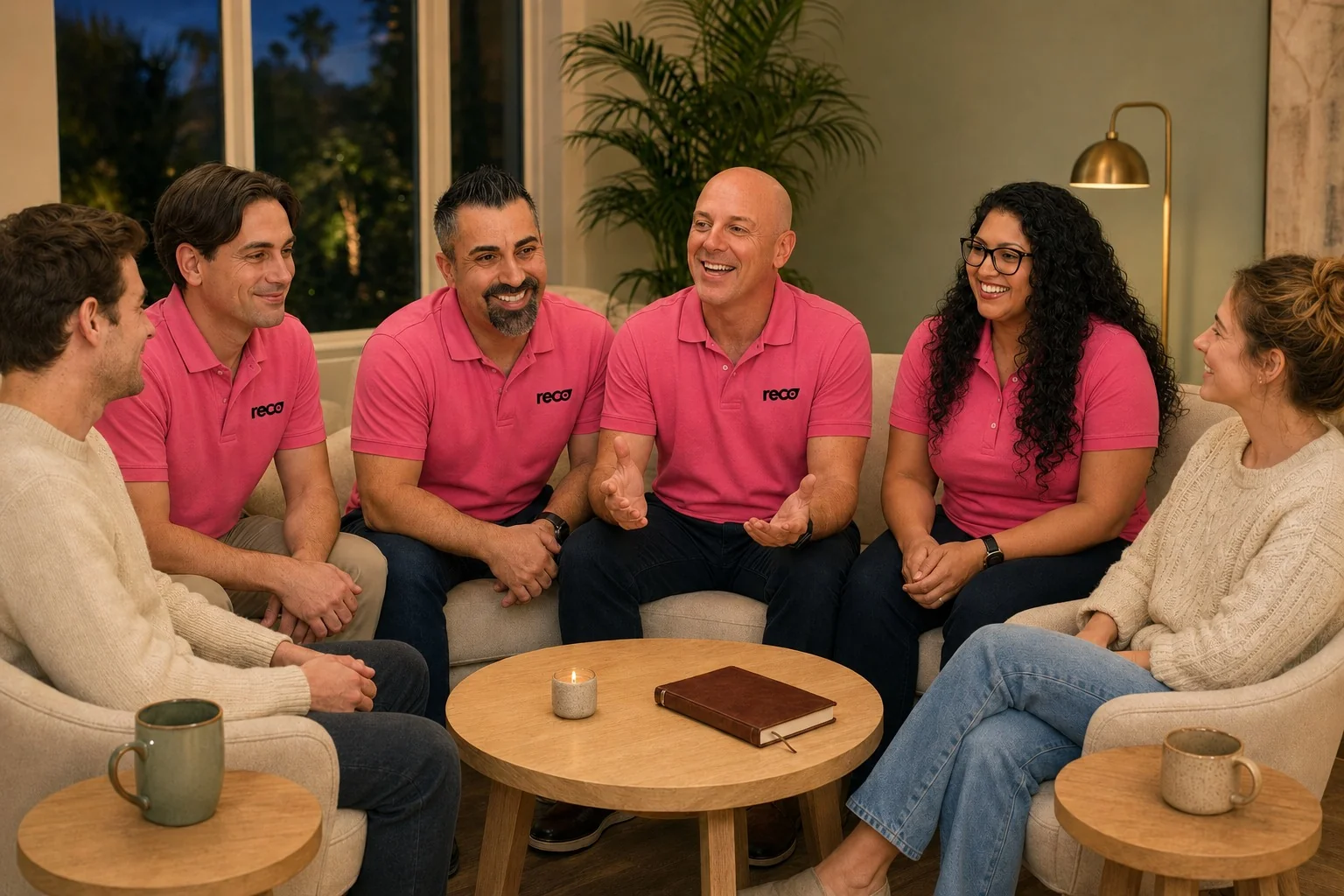
What continuum of care actually means when the same therapist stays with you
The phrase "continuum of care" appears in nearly every treatment program's marketing. It usually describes a menu of levels: detox, residential, PHP, IOP, outpatient. What it rarely describes is whether anything connects those levels besides a discharge summary faxed from one program to the next.
At RECO, the connection between levels is a person. Your primary therapist conducts your intake assessment, begins the therapeutic relationship during residential treatment, and continues individual sessions as you step down to partial hospitalization at ASAM Level 2.5 and then to intensive outpatient at ASAM Level 2.1. The case conceptualization does not reset. The relationship does not reset. The clinical understanding of what drives your use, what your relapse triggers look like, and what your recovery environment needs to provide accumulates rather than starting over at each new program entrance.
Sober living, for clients who need a structured recovery environment between IOP and independent living, is coordinated by the same clinical team. The transition is planned, not improvised at discharge.
Aftercare at RECO is structured. Alumni programming includes weekly check-in groups, individual check-ins with the primary therapist at clinically indicated intervals, and a community of people at different stages of recovery who are accessible to clients who are newly out of intensive treatment. The first 90 days after leaving a structured program are the highest-risk period in early recovery. RECO's aftercare design reflects that reality.
If you are comparing programs, one useful question is: who will your therapist be in week one, and will that same person still be your therapist in month three? At RECO, the answer is yes.
Outcomes measured in years, not discharge statistics
The addiction treatment field has a data problem. Programs report completion rates, 30-day sobriety rates, or client satisfaction scores because those are the numbers that are easy to collect at discharge. They are also the numbers least likely to predict whether someone is sober two years later.
RECO does not publish outcome statistics that cannot be verified. What RECO does is build a clinical model designed for long-term recovery rather than for program completion. Those are different goals that produce different clinical decisions throughout treatment.
Long-term recovery is built during treatment through relapse prevention planning that is specific, not generic. It names the exact people, places, and emotional states that have historically preceded use. It builds coping strategies that are rehearsed in session, not handed to a client in a printed handout at discharge. It identifies the support structures, both professional and community-based, that will be in place before the client leaves intensive treatment.
RECO's alumni community is active. People one year out of treatment, three years out, five years out, participate in programming alongside people who are newly out of IOP. That visibility matters clinically. Early recovery is sustained in part by contact with evidence that sustained recovery is possible. The alumni network at RECO provides that evidence in a form that is more persuasive than any statistic: people who are living it.
If you want to speak with someone about what recovery has looked like for people who came through RECO's program, that conversation is available. Call (866) 396-2008.
Seven principles that shape every clinical conversation.
Recovery is not linear, and treatment should not pretend it is
The therapeutic relationship is not a luxury, it is the mechanism
Family heals together or recovery is harder for everyone
Specialist knowledge produces better clinical decisions
Medication-assisted treatment is a clinical tool, not a compromise
Discharge is a transition, not a conclusion
Accurate assessment takes time and determines everything downstream
The questions families ask first.
If you don't see your question here, our admissions team is on the phone live — confidential, no commitment, no pressure.
How is RECO Intensive different from other Florida treatment centers?
What does evidence-based treatment mean at RECO, specifically?
Do you treat addiction alone, or addiction together with mental health conditions?
How is family involved in the treatment process?
What is the role of medication-assisted treatment in your approach?
How long is a typical treatment journey at RECO?
What happens after my loved one or I finish the intensive treatment program?
How is trauma addressed in your approach?
The first conversation is free, confidential, no commitment.
Insurance verified in two minutes. We're honest about whether RECO is the right fit — including referring elsewhere when it's not.