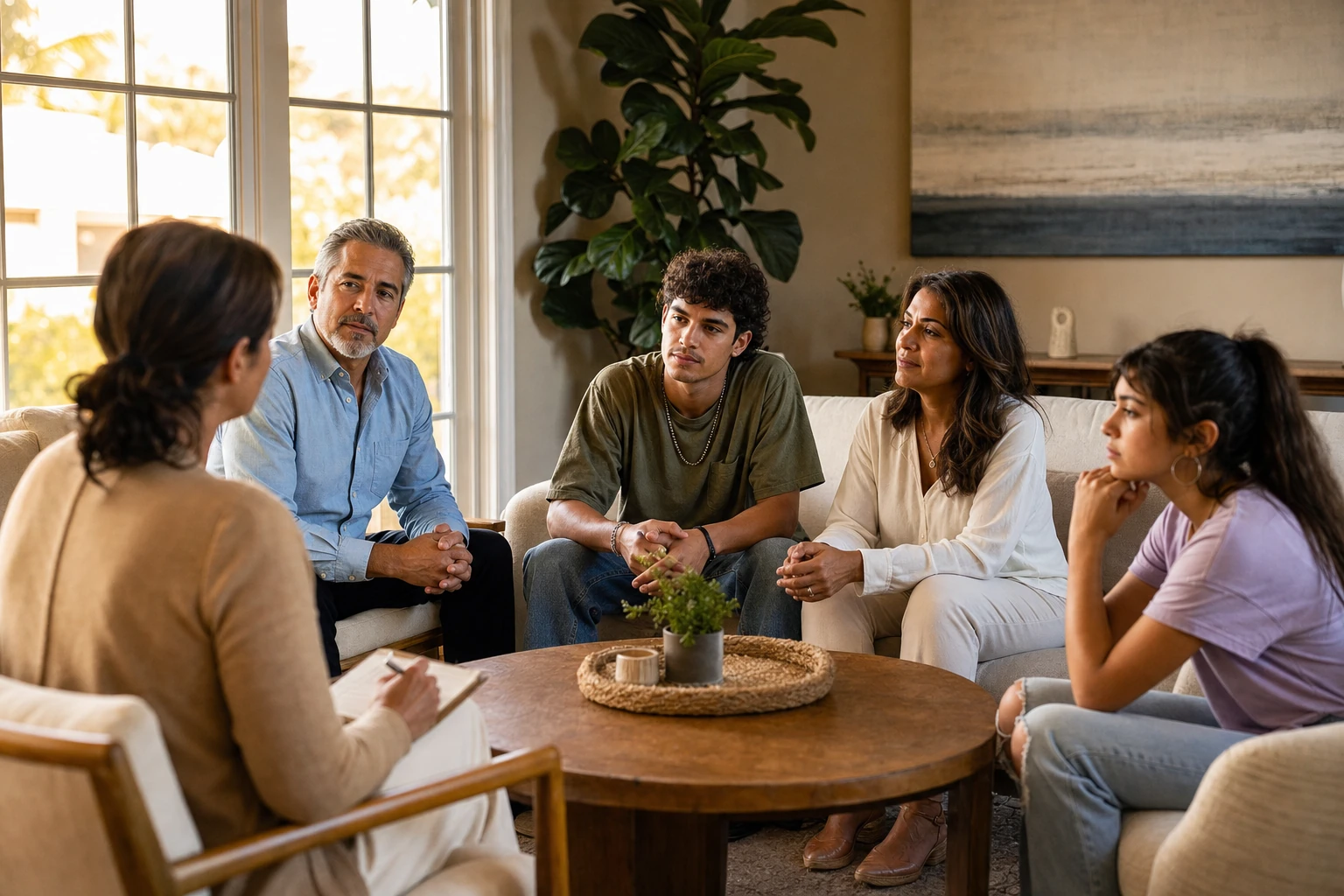
Addiction is rarely just an individual disease. It develops in a family system and either gets reinforced or healed in one. RECO Intensive's family-systems support group works the relational territory directly — not just teaching families about addiction, but engaging the family's actual dynamics.
What family-systems work looks like at RECO Intensive
The group runs weekly and is facilitated by a clinician trained in family-systems theory (Bowen, structural family therapy, internal family systems). Clients bring their family dynamics into the group — the patterns of communication, the roles family members take, the unspoken rules that organize the system. The group helps name and work with those patterns.
For clients whose family is engaged in treatment, the work in this group feeds direct family-therapy sessions with the family present. For clients whose family won't or can't engage, the work still happens — family-of-origin patterns show up in present relationships even when family-of-origin members aren't in the room.
What the group works on
- Family roles — hero, scapegoat, lost child, mascot, enabler
- Multi-generational patterns of addiction and recovery
- Communication patterns — direct, oblique, withholding
- Boundaries and the difference between healthy boundaries and walls
- Codependency and enmeshment
- How present-day relationships replicate family-of-origin dynamics
Who family-systems work serves best
Almost every client benefits. The work matters most for clients with significant family-of-origin trauma, multi-generational addiction patterns, clients in active conflict with parents or partners, and clients whose family system is either deeply engaged or deeply absent from treatment.
How this integrates with the rest of treatment
Material from this group feeds individual therapy and direct family-therapy sessions (where the family is present). Aftercare planning incorporates family-system findings — because returning home to an unchanged family system is one of the higher-risk discharge scenarios.
Why the RECO approach is different
Many programs treat family work as an information session for families. We treat it as clinical work that happens with or without the family present, because the patterns the family installed are inside the client — and that's where the work can always happen.